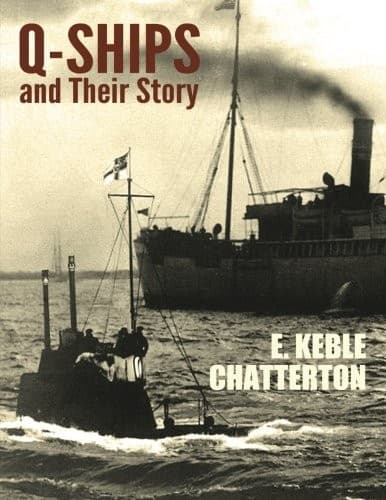
Q-Ships and Their StoryChatterton, E. Keble (Edward Keble)
History
Q-Ships and Their Story
Chatterton, E. Keble (Edward Keble)
Q-ships; World War, 1914-1918 -- Naval operations
Nothing further happened until half an hour later, when a larger
submarine with sail set, about the size of a drifter’s mizzen, was
sighted right aft. As soon as this U-boat bore 3 points on the port
quarter, she also was attacked, and dived under cover of her smoke
screen. The afternoon passed, and at dusk (7 p.m.), when there was
still no wind, the sound of a submarine’s motors was heard as if
circling around the brigantine. An hour later _Helgoland_ bent her new
foretopsail, and just before 9.30 a submarine was seen right ahead,
so in the calm the Q-ship could not get her guns to bear. Half an
hour later, as there was still no wind, _Helgoland_ spoke an armed
trawler, who towed her back to Falmouth. Just as the two ships were
communicating, the enemy fired a couple of torpedoes which, thanks to
_Helgoland’s_ shallow draught, passed under her amidships. So ended the
brigantine’s first cruise. It was unfortunate that at long range she
had been compelled to open fire and disclose her identity, but that was
owing to the calm, and subsequently she was fitted with an auxiliary
motor.
[Illustration: FIG. 6.—DIAGRAM TO ILLUSTRATE APPROXIMATE MOVEMENTS OF
‘HELGOLAND’ AND SUBMARINE ON OCTOBER 24, 1916.]
Her next fight was in much the same position, about 20 miles S.W.
of the Lizard. At 6.20 a.m. on October 24, 1916, _Helgoland_, now
commanded by Lieutenant G. G. Westmore, R.N.R., was on an E.S.E.
course, the wind being S.W., force 4, and there was a moderate sea.
About a mile off on the starboard bow was a large tramp steamer
steering a westerly course, and presently was seen a submarine
following astern of the tramp. Lieutenant Westmore at once sent his
crew to quarters, keeping all of them out of sight, with the exception
of the ratings who represented the watch that ordinarily would be seen
on the deck of such a coaster. In order to pass close to the German,
the brigantine hauled to the wind, and at 6.42 the submarine opened
fire on the steamer. As the enemy was now abeam, and only 1,000 yards
to windward of the _Helgoland_, Lieutenant Westmore determined that
this was the opportune moment. To wait longer would only have meant an
increase in the range; so down went the screens and fire was opened
with the starboard guns. The second and third shots seemed to strike
the enemy amidships, and she then dived, after firing only one round,
which passed well astern. Everything had worked well except that the
screen had jammed at the critical moment, but Lieutenant Sanders,
who was seeing that guns and crew were ready, soon cleared it. While
he was looking after his men, and Lieutenant Westmore was generally
looking after the ship, Skipper William Smith, R.N.R., was at the wheel
steering with marked coolness, and Skipper R. W. Hannaford, R.N.R.,
was in charge of the sails, handling them and trimming the yards as
required.
Public-domain text, read in full here on John Shaqi.
Reviews
Reviews
No reviews yet
Be the first to share your thoughts on this work.
Join the Discussion
Join the discussion
Sign in to leave a comment or review.
Sign InorCreate an account