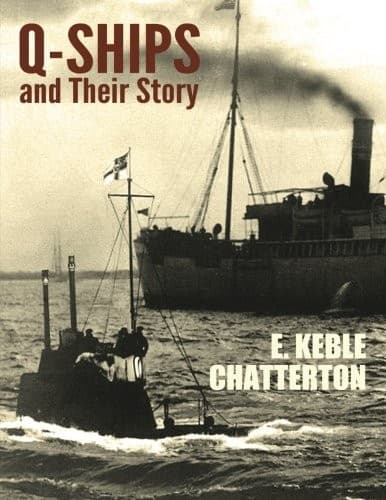
Q-Ships and Their StoryChatterton, E. Keble (Edward Keble)
History
Q-Ships and Their Story
Chatterton, E. Keble (Edward Keble)
Q-ships; World War, 1914-1918 -- Naval operations
The first submarine was painted a dark colour, with a brown sail set
aft, so that at first she resembled one of our drifters. And now a
second U-boat, painted a light colour with no sail, was seen two
miles away heading for the tramp steamer. The latter happened to be
the Admiralty transport _Bagdale_, whose crew had by now abandoned
her, the ship’s boats being close to the submarine. _Helgoland_ went
about on the other tack and stood towards the enemy, so as to save the
_Bagdale_, and at 4,000 yards fired at the submarine. The latter was
not hit, dived, came to the surface and made off to the south-west,
not being seen after this. The brigantine stood by the abandoned
_Bagdale_, tacking ship at frequent intervals, so as to prevent the
submarine resuming her onslaught. Soon after nine two trawlers were
observed, and summoned by gunfire and rockets. They were sent to
pick up the crew and to tow the transport into Falmouth. Thus, if no
submarine had been sunk, this sailing ship had saved the steamer by
frightening away the enemy, and there were more engagements still to
follow.
By this—October, 1916—the Q-ship service had increased to such an
extent that there were actually forty-seven decoy craft operating.
These comprised almost every kind of vessel, from motor drifters to
medium-sized steamers. Their success or failure depended partly on
captain and crew, but partly on luck. Some Q-ships, as we have seen,
never sighted a U-boat; others were in action as soon as they got out
of port. The advantage of these Q-sailing-ships was that they could
keep the sea independent of the shore for periods much longer than
the trawlers or tramps. Owing to their roomy decks, these coasters
were well suited for the erection of dummy deckhouses to conceal the
armament, and another advantage was that, not utilizing engines or a
propeller—except when used occasionally—there was no noise to prevent
constant listening on the hydrophones. There was always the chance that
during the dark hours, when the enemy on his hydrophones could not hear
the sailing ship approaching, the schooner or brigantine might suddenly
surprise and sink a submarine lying on the surface charging its
batteries. The result was that in the first week of November another
sailing craft was requisitioned. This was the three-masted barquentine
_Gaelic_, which was then lying at Swansea loaded with 300 tons of
coal. _Gaelic_, who was known officially afterwards also under the
names of _Gobo_, _Brig_ 11, and Q 22, was 126 feet 8 inches long and 21
feet in the beam. She had been built of iron in 1898, was registered at
Beaumaris, and remained in service throughout the rest of the war. In
August, 1918, she was operating in the Bay of Biscay, and then returned
to Gibraltar. At the end of November she left ‘the Rock,’ reached
Falmouth by the middle of December, and then was towed to Milford to be
paid off, reconditioned, and returned to commercial work. But before
Public-domain text, read in full here on John Shaqi.
Reviews
Reviews
No reviews yet
Be the first to share your thoughts on this work.
Join the Discussion
Join the discussion
Sign in to leave a comment or review.
Sign InorCreate an account