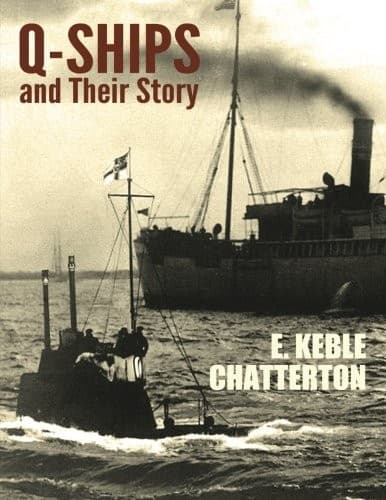
Q-Ships and Their StoryChatterton, E. Keble (Edward Keble)
History
Q-Ships and Their Story
Chatterton, E. Keble (Edward Keble)
Q-ships; World War, 1914-1918 -- Naval operations
then, as we shall presently see, she was to carry out some first-class
work.
There is no person more conservative than the seafaring man; the whole
history of the sailing ship shows this clearly enough, and it is
curious how one generation is much the same as another. It was Lord
Melville who, in the early years of the nineteenth century, stated
that it was the duty of the Admiralty to discourage, to the utmost of
their ability, the employment of steam vessels, as they considered
the introduction of steam was calculated to strike a fatal blow to
the naval supremacy of Great Britain. A hundred years later, although
the Q-sailing-ship had justified herself, yet there was a sort of
conservative prejudice against her development. ‘The small sailing
vessel,’ complained a distinguished admiral, ‘will develop into a
sailing line-of-battle ship with an electric-light party reefing
topsails and a seaplane hidden in the foretopmen’s washdeck locker, and
everybody seasick.’
Yes: there was much in common between this flag-officer and the noble
lord, in spite of the intervening century.
CHAPTER VI
THE ‘MARY B. MITCHELL’
It was the activities and successes of the submarines in the western
end of the English Channel that had made these small Q-sailing-ships so
desirable. The first of these to be used in that area was the _Mary B.
Mitchell_. She was a three-masted topsail steel schooner owned by Lord
Penrhyn. Built at Carrickfergus in 1892 and registered at Beaumaris,
she was 129 feet in length, and of 210 tons gross. In the middle of
April, 1916, she happened to be lying in Falmouth with a cargo of china
clay, and it was decided to requisition her. The difficulty always was
to preserve secrecy during her fitting out, but in this case, luckily,
she had recently suffered some damage, and this afforded an excellent
excuse for paying off the mercantile crew. A new crew was selected for
her and was trained specially for the work while she was being got
ready for her special service. She was commissioned on May 5, and left
Falmouth for her first cruise on June 26, and then operated for a month
on end in the western approaches between Ushant, the Irish coast, and
Milford.
Her captain was Lieutenant M. Armstrong, R.N.R., and she was known
officially as the _Mitchell_ and Q 9. During her cruising she sailed
also under three different neutral flags, as convenient. Armed with
three guns, her 12-pounder was hidden in a dummy collapsible house on
the poop, and under each of the two hatches was a 6-pounder mounted on
a swinging pedestal. There were also a couple of Lewis guns, some small
arms and Mills hand-grenades. In spite of the thoroughness with which
the guns were concealed, the collapsible arrangements had been made
so ingeniously that all guns could be brought into action under three
seconds. Before leaving Falmouth she was painted black with a yellow
streak and bore the name
MARY Y. JOSE
VIGO
Public-domain text, read in full here on John Shaqi.
Reviews
Reviews
No reviews yet
Be the first to share your thoughts on this work.
Join the Discussion
Join the discussion
Sign in to leave a comment or review.
Sign InorCreate an account