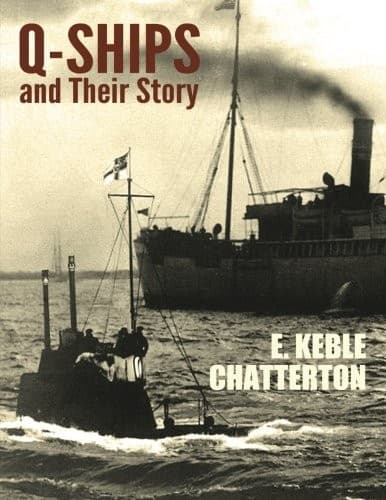
Q-Ships and Their StoryChatterton, E. Keble (Edward Keble)
History
Q-Ships and Their Story
Chatterton, E. Keble (Edward Keble)
Q-ships; World War, 1914-1918 -- Naval operations
A further engagement with what was probably the same enemy occurred
later on the same day. It was a favourite tactic for a submarine to
follow a ship after disappearing for a while, and then, having got her
hours later in a suitable position, to attack her again. I used to hear
commanding officers say that they had certainly noticed this in regard
to their own ships, and there are not lacking actual records of these
methods, especially in the case of the slow-moving sailing Q-ships who
could be seen across the sea for a long time; and it was part of these
tactics to carry out this second attack just before night came on. Thus
at 6.10 p.m., being now in Lat. 47.37 N., Long. 6.38 W., _Mitchell_
again sighted a submarine, this time 4 miles away on the port quarter.
The schooner kept her course, the submarine overtook her, and at 6.35
again shelled the ship. After the U-boat had fired half a dozen rapid
rounds, _Mitchell_ was hove-to and ‘abandoned,’ the enemy taking up a
position well out on the port beam and firing until the boat was quite
clear of the ship. Then the German stopped, exactly on the beam, 800
yards away, and waited for a long time before making any move. Suddenly
he turned end on, came full speed towards the ship, dived, and when 400
yards away showed his periscope on the port side. Having got to within
50 yards he went full speed ahead, starboarded his helm, and began to
rise quickly. As soon as the top of the conning-tower appeared and a
couple of feet of hull were showing _Mitchell_ cleared away and shelled
him with the after 6-pounder. This seemed to pierce the conning-tower,
a large blue flash and a volume of yellow vapour coming from the hole.
Almost simultaneously the 12-pounder hit the enemy in the bows, but
after this the enemy was too far forward for the schooner’s guns to
bear. In a cloud of black smoke, yellow smoke, steam, and spray, she
dived and was not seen again until 8.7 p.m. on the surface 5 miles to
the westward, just as the ‘panic party’ were coming back on board the
schooner. All speed was made, and the boat towed astern on an easterly
course for the French coast. For a time the submarine followed, but
then went off to the north-eastward and remained in sight until dark.
The reader may wonder how a submarine, having once been holed, could
remain afloat: but there are cases of undoubted authenticity where,
in spite of being seriously injured, the submarine did get back to
Germany. A remarkable instance of one thus damaged by a Q-sailing-ship
will be given in a later chapter. But in the present case of the
_Mitchell_, even if she had not sunk her submarine, she had fought two
plucky engagements, in the opinion of the Admiralty, and the captain,
Lieutenant John Lawrie, R.N.R., already the possessor of a D.S.C., was
now awarded the D.S.O.—his two officers, Lieutenant John Kerr, R.N.R.,
and Lieutenant T. Hughes, R.N.R., being given each a D.S.C.
Public-domain text, read in full here on John Shaqi.
Reviews
Reviews
No reviews yet
Be the first to share your thoughts on this work.
Join the Discussion
Join the discussion
Sign in to leave a comment or review.
Sign InorCreate an account