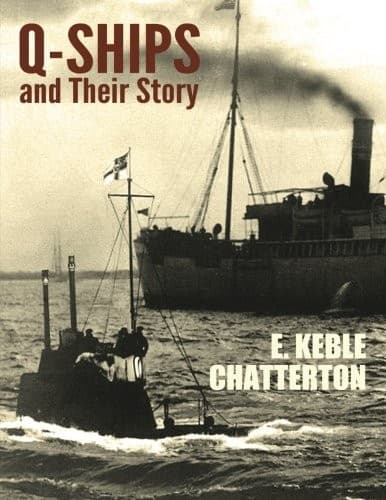
Q-Ships and Their StoryChatterton, E. Keble (Edward Keble)
History
Q-Ships and Their Story
Chatterton, E. Keble (Edward Keble)
Q-ships; World War, 1914-1918 -- Naval operations
On the following August 3, when 20 miles south of the Start, _Mitchell_
had yet another engagement. She had left Falmouth two days before as
the _Arius_, of Riga, then as the French _Cancalais_, of La Houle,
and cruised between the Lizard and the Owers, to Guernsey, and in the
neighbourhood of Ushant. At 1.45 p.m. she was sailing close-hauled on
the starboard tack, steering west; there was a fresh breeze, rather
a rough sea, and a slight haze. Three miles away on the starboard
beam appeared a submarine, who five minutes later began shelling the
schooner. Lawrie let his ship fall off the wind, and the shells came
bursting around, passing through sails and rigging, so after ten
minutes of this the schooner hove-to and ‘abandoned’ ship. Slowly and
cautiously the submarine approached, and when about 3,000 yards off
stopped his engines, but continued to fire. Then he came up on the
decoy’s starboard beam, about 1,000 yards away; but after fifteen
minutes of shelling from this position, Lawrie decided that he could
tempt the enemy no nearer. It was now 4 p.m., so _Mitchell_ started
her motor, cleared away all disguises, put the helm hard aport, and so
brought the enemy well on the beam, allowing all four guns to bear.
Over twenty shells were fired, of which three or four hit the base of
the conning-tower; but the submarine, having replied with four shots,
dived, and made off. For two hours and a quarter had this engagement
been prolonged, and the enemy must have been considerably annoyed to
have wasted seventy of his shells in this manner. There was every
reason to suppose that he had received injuries, and though there were
no fatalities aboard the schooner, yet the latter’s windlass, sails,
rigging, and deck fittings had been damaged, and two of her men had
been wounded. Lieutenant Lawrie received for this gallant fight a bar
to his D.S.C., and a similar award was made to Lieutenant T. Hughes.
Such, briefly, was the kind of life that was spent month after month
in these mystery sailing ships. It was an extraordinary mixture of
monotony and the keenest excitement. From one hour to another no
man knew whether he would be alive or dead, and the one essential
thing consisted in absolute preparedness and mental alertness. To
be surprised by the enemy was almost criminal; to escape narrowly
from shipwreck, to remain unmoved under shell-fire, to see the spars
crashing down and your shipmates laid out in great pain, to be hit and
yet refusing to hit back until the right moment, to keep a clear head
and a watchful eye, and all the time handle your ship so that the most
was got out of the wind—all this was a part of your duty as a Q-ship
man. Officers and men believed that if their Q-ship were torpedoed and
any of them were captured, they would be shot as _francs-tireurs_.
German prisoners had not hesitated to make this statement, although I
do not remember an instance where this was carried out.
Public-domain text, read in full here on John Shaqi.
Reviews
Reviews
No reviews yet
Be the first to share your thoughts on this work.
Join the Discussion
Join the discussion
Sign in to leave a comment or review.
Sign InorCreate an account