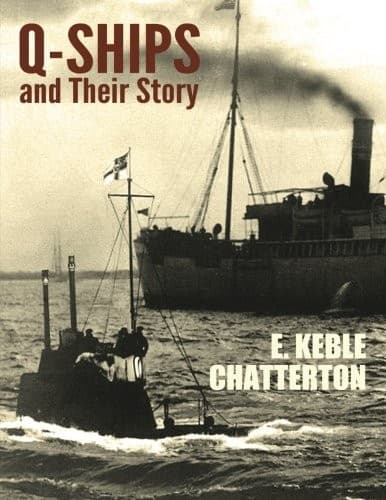
Q-Ships and Their StoryChatterton, E. Keble (Edward Keble)
History
Q-Ships and Their Story
Chatterton, E. Keble (Edward Keble)
Q-ships; World War, 1914-1918 -- Naval operations
The following pages are an attempt to place before the reader a series
of sea struggles which are unique, in that they had no precedent in
naval history. If you consider all the major and minor sea fights
from the earliest times to the present day; if you think of fleet
actions, and single-ship contests, you cannot surpass the golden story
of the Q-ships. As long as people take any interest in the untamed
sea, so will these exploits live, not rivalling but surpassing the
greatest deeds of even the Elizabethan seamen. During the late war
their exploits were, for very necessary reasons, withheld from the
knowledge of the public. The need for secrecy has long since passed,
and it is high time that a complete account of these so-called ‘mystery
ships’ should be published, not merely for the perpetuation of their
wonderful achievements, but for the inspiration of the new race of
seamen whose duty it will be to hand on the great tradition of the sea.
For, be it remembered, the Q-ship service was representative of every
species of seamen. There were officers and men of the Royal Navy both
active and retired, of the Royal Naval Reserve, Royal Naval Volunteer
Reserve, and men from the Royal Fleet Reserve. From warship, barracks,
office, colony, pleasure yacht, fishing vessel, liner, sailing ship,
tramp steamer, and elsewhere these seafarers went forth in unarmoured,
slow-moving, lightly-armed vessels to perform the desperate adventure
of acting as live-bait for a merciless enemy. It was an exploit
calling for supreme bravery, combined with great fighting skill, sound
seamanship, and a highly developed imagination. The successes which
were attained were brought about by just this combination, so that
the officers, especially the commanding officers, and the men had
to be hand-picked. The slow-reasoning, hesitating type of being was
useless in a Q-ship; equally out of place would have been the wild,
hare-brained, dashing individual whose excess of gallantry would
simply mean the loss of ship and lives. In the ideal Q-ship captain
was found something of the virtues of the cleverest angler, the most
patient stalker, the most enterprising big-game hunter, together with
the attributes of a cool, unperturbed seaman, the imagination of a
sensational novelist, and the plain horse-sense of a hard business man.
In two words, the necessary endowment was brains and bravery. It was
easy enough to find at least one of these in hundreds of officers, but
it was difficult to find among the many volunteers a plucky fighter
with a brilliant intellect. It is, of course, one of the happy results
of sea training that officer or man learns to think and act quickly
without doing foolish things. The handling of a ship in bad weather,
or in crowded channels, or a strong tideway, or in going alongside
a quay or other ship—all this practice makes a sailor of the man,
makes him do the one and only right thing at the right second. But it
Public-domain text, read in full here on John Shaqi.
Reviews
Reviews
No reviews yet
Be the first to share your thoughts on this work.
Join the Discussion
Join the discussion
Sign in to leave a comment or review.
Sign InorCreate an account