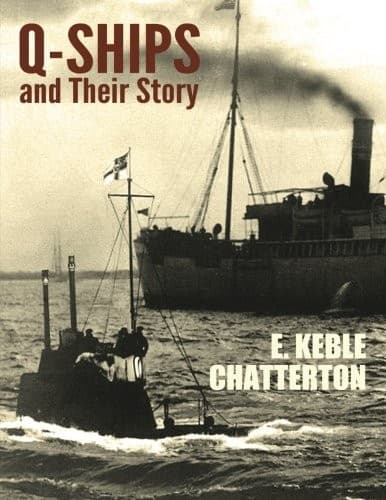
Q-Ships and Their StoryChatterton, E. Keble (Edward Keble)
History
Q-Ships and Their Story
Chatterton, E. Keble (Edward Keble)
Q-ships; World War, 1914-1918 -- Naval operations
of her personnel. Lieutenant Naylor received a bar to his D.S.O., the
ship had a thorough refit, and in place of a 12-pounder she was now
given a 4-inch gun, which would enable her to fight the 4·1-inch U-boat
gun on more equal terms.
Then, still commanded by Lieutenant Naylor, she went forth again. We
can pass over the intervening weeks and come to Christmas Eve, 1917. At
a time when most non-combatants ashore were about to take part in the
great festival, this most gallant ship, heroine of so many fights, was
in the direst straits. At midday she was approaching the southern end
of the Irish Sea, shaping a course to intercept a submarine operating
off the Smalls, when ten minutes later she sighted a U-boat two points
on the port bow, in Lat. 51.31 N., Long. 5.33 W., about 5 miles ahead,
steering at right angles to _Penshurst_ and beginning the ‘approach’ of
her attacking tactics. _Penshurst_ was making her usual 8 knots, and at
12.12 p.m. the enemy, as was expected, submerged. Although the Q-ship
zigzagged and tried to make the enemy break surface astern and attack
by gunfire, the German was too good at his own job, and at 1.31 p.m.
came the torpedo, fired from 300 yards away, half a point forward of
the port beam. Only the track of the torpedo was seen, the ship’s helm
was put hard aport, but the torpedo could not be avoided and struck the
ship between the boilers and engine-room.
Violent was the explosion, great was the damage, so that the ship
stopped dead and began to settle by the stern. The sides of the dummy
boat amidships had fallen down, thus exposing the midships 4-inch gun,
and the after gunhouse had also collapsed, revealing the guns here
placed, though the 12-pounder guns on the bridge remained intact and
concealed, with the guns’ crews close up and out of sight. The ship was
now ‘abandoned,’ and panic parties were sent away in the one remaining
boat and two rafts. The enemy, still submerged, proceeded to circle the
ship, inspect her closely, approach the boat and rafts, and then at
2.40 p.m. rose to the surface on the port bow 250 yards off and began
shelling _Penshurst_ with her after gun. The Q-ship was about to open
fire, but, owing to having settled down so much by the stern, the gun
there could not be sufficiently depressed to bear. It was only when
the ship rolled or pitched enough that advantage was taken of such
movement and the enemy fired at. Six rounds were fired, the second
hitting the submarine on the starboard side of the deck forward, the
fourth hitting abaft the conning-tower. The enemy dived, and at 3.47
p.m. reappeared on the starboard beam 5 miles away. But now one of H.M.
P-boats, those low-lying, specially constructed anti-submarine craft,
rather like a torpedo-boat, arrived on the scene, so that the submarine
was frightened away and not sighted again on that day, though she was
probably the one sunk by a P-boat on Christmas Day.
Public-domain text, read in full here on John Shaqi.
Reviews
Reviews
No reviews yet
Be the first to share your thoughts on this work.
Elsewhere in the archive
Join the Discussion
Join the discussion
Sign in to leave a comment or review.
Sign InorCreate an account