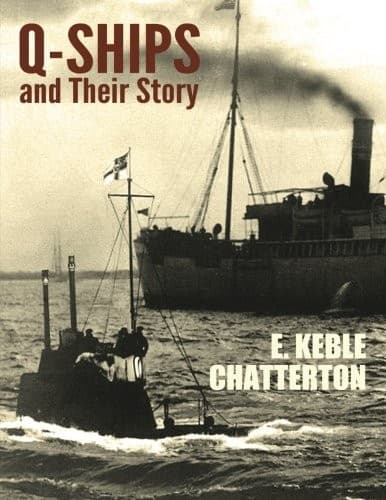
Q-Ships and Their StoryChatterton, E. Keble (Edward Keble)
History
Q-Ships and Their Story
Chatterton, E. Keble (Edward Keble)
Q-ships; World War, 1914-1918 -- Naval operations
As for _Penshurst_, help had come too late. The crew were saved, but
the ship herself sank at 8.5 p.m. on December 24, 1917. Lieutenant
Cedric Naylor, who already possessed the decorations of D.S.O. and bar
and D.S.C., and had for his gallantry been transferred from R.N.R. to
the Royal Navy, now received a second bar to his D.S.O., and Lieutenant
E. Hutchison, R.N.R., received a D.S.O. Thus after two years of the
most strenuous service, full of honours, this _Penshurst_ ended
her glorious life as a man-of-war. Wounded, scar-stained, repaired
and refitted, her gallant crew, so splendidly trained by Captain
Grenfell, had kept taking her to sea along the lanes of enemy activity.
Insignificant to look at, when you passed her on patrol you would
never have guessed the amount of romance and history contained in her
hull. Naval history has no use for hysteria and for the sensational
exaggeration of ‘stunt’ journalism, but it is difficult to write calmly
of the great deeds performed in these most unheroic-looking ships.
To-day some Q-ship officers and men are walking about looking for jobs,
and there are not ships in commission to employ them. But yesterday
they were breaking the spirit of the U-boat personnel, risking their
lives to the uttermost limits in the endeavour to render ineffectual
the submarine blockade and the starvation of the nation.
Bravery such as we have seen in this and other chapters was greater
than even appears: for, having once revealed the identity of your ship
as a man-of-war, the wounded submarine would remember you, however
much you might disguise yourself; and the next time he returned, as
he usually did, to the same station, he would do his best to get you,
even if he spent hours and days over the effort. That officers and men
willingly, eagerly, went to sea in the same Q-ships, time after time,
when they might have obtained, and would certainly have deserved, a
less trying appointment afloat or ashore, is surely a positive proof
that we rightly pride ourselves on our British seamanhood. Through the
centuries we have bred and fostered and even discouraged this spirit.
In half-decked boats, in carracks, galleons, wooden walls, fishing
boats, lifeboats, pleasure craft; in steam, and steel-hulled motor,
cargo ships, in liner and tramp and small coaster, this seamanlike
character has been trained, developed, and kept alive, and now in the
Q-ship service it reaches its apotheosis. For all that is courageous,
enduring, and inspiring among the stories of the sea in any period, can
you beat it? Can you even equal it?
CHAPTER X
FURTHER DEVELOPMENTS
Public-domain text, read in full here on John Shaqi.
Reviews
Reviews
No reviews yet
Be the first to share your thoughts on this work.
Elsewhere in the archive
Join the Discussion
Join the discussion
Sign in to leave a comment or review.
Sign InorCreate an account