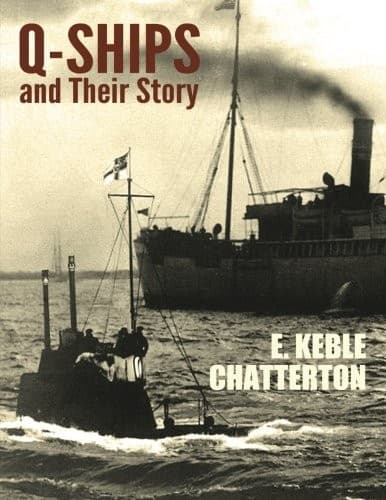
Q-Ships and Their StoryChatterton, E. Keble (Edward Keble)
History
Q-Ships and Their Story
Chatterton, E. Keble (Edward Keble)
Q-ships; World War, 1914-1918 -- Naval operations
The Q-ships operated not merely in the North Atlantic, English Channel,
North Sea, and Mediterranean, but in such areas as off Lapland and the
other side of the North and South Atlantic. For instance, the S.S.
_Intaba_ (Q 2), under Commander Frank Powell, on December 8, 1916, was
in action with a submarine not far from the Kola Inlet, and had been
sent to these northern latitudes inasmuch as German submarines for
some time had been sinking our merchant ships off that coast. Another
Q-ship operated with a British E-class submarine near Madeira and the
Canaries; and another Q-ship was in the South Atlantic looking for a
German raider, At other times there were the ocean-going submarines
_Deutschland_ and _Bremen_ to be looked out for. There was thus plenty
of work to be carried out by these decoy vessels in almost every sea.
But it was especially those Q-ships based on Queenstown who had to
bear the brunt of the submarine warfare. Strategically, Queenstown
was an outpost of the British Isles, and there was scarcely a day in
the week when one Q-ship was not leaving or entering Queenstown, or in
the Haulbowline Dockyard being got ready for her next ‘hush’ cruise.
Bearing in mind that this base was in a country whose inhabitants
were largely anti-British, that there had been a great rising in
Dublin at Eastertide, 1916, and that the German disguised S.S. _Aud_
had made an ineffectual attempt to land a cargo of arms, and that
Sir Roger Casement had arrived, it may well be realized how great
was the responsible task of enshrouding these decoys in secrecy.
Perhaps for weeks a recently requisitioned ship would be alongside
the dockyard quay having her necessary disguises made, and yet the
enemy knew nothing about it until he found himself surprised, and
forced to keep at long range or hide himself in the depths of the sea.
Sound organization, constant personal attention on the part of the
Commander-in-Chief, and loyal, enthusiastic co-operation on the part
of the officers and men, achieved the successes which came to this
difficult work of Q-ships. It was all such a distinctly novel kind
of sea service, which was of too personal and particular a kind to
allow it to be run by mere routine. During the whole of its history
it was experimental, and each cruise, each engagement, almost each
captain added to the general body of knowledge which was being rapidly
accumulated. It seemed for the professional naval officer as if the
whole of his previous life and training had been capsized. Instead of
his smart, fast twin-screw destroyer, he found himself in command of an
awkward, single-screw, disreputable-looking tramp, too slow almost to
get out of her own way. On the other hand, officers of the Mercantile
Marine, fresh from handling freighters or liners, in whom throughout
all their lives had been instilled the maxim ‘Safety first,’ now found
they had to court risks, look for trouble, and pretend they were not
men-of-war.
Public-domain text, read in full here on John Shaqi.
Reviews
Reviews
No reviews yet
Be the first to share your thoughts on this work.
Elsewhere in the archive
Join the Discussion
Join the discussion
Sign in to leave a comment or review.
Sign InorCreate an account