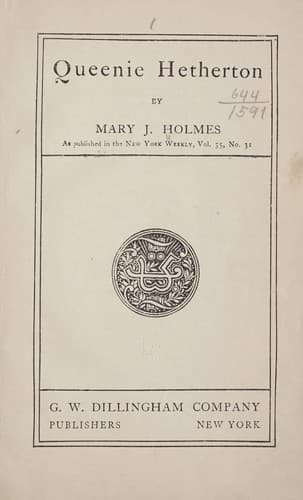
American fiction -- 19th century; Dime novels; Man-woman relationships -- Fiction; Upper class -- Fiction
“I sent him away!—sent him to India to die, as he will! No, no; I did
not do that,” Queenie cried, piteously. “I said I could not marry him,
and he my cousin; and I could not, any more than you could marry him, he
being your brother. But I did not think he’d go away. Oh! what shall we
do without Phil?”
Reinette was sobbing passionately, and Ethel and Grace were crying with
her, for Phil had made the happiness of their lives, and without him
they were very desolate.
“Did he speak of me?” Queenie asked, at last. “Did he leave no word? no
message? no good-by?”
“He left this for you,” Ethel said, passing the letter to Queenie, who
clutched it eagerly, but would not read it there with the sisters
looking on. That they blamed her, and held her responsible for Phil’s
India trip, she was certain, and she felt glad when they at last said
good-night, and left her to herself and her letter—Phil’s letter—which
she read in the privacy of her room, and which nearly broke her heart.
“Dear Queenie,” he began, “I am going away—for a year certainly, and
perhaps, forever, for men of my habits, who have never been accustomed
to hardships of any kind, die easily in that hot climate.”
“Oh-h!” and Reinette groaned bitterly, as she thought, “Why did Phil say
what will make me feel like his murderer, if he should die out there.”
Then she read on:
“I am going to India on business for a firm in New York, of which Mr.
Beresford’s uncle is the head. The salary is good, and the duties such
as I can perform, and so I am going. Mr. Beresford made me the offer
this morning, and with my usual indolence I declined it, but I did not
then know your opinion of me; did not know how you despised me for my
effeminacy and laziness. Queenie, I do believe that hurt me more than
your refusal of me. I might live without your love, perhaps, but not
without your respect, and so I am going to begin life anew, with some
aim, some occupation, and you shall never taunt me again with my
idleness. But oh, Queenie, how I love you, and how I long to hold you in
my arms as my own darling. It is a strange power which you have over us
men—a power to hold us at your will by one glance of your eyes, or toss
of your head. Other faces may be more beautiful than yours; some would
say that Margery La Rue’s was one of them, but there is something about
you more attractive than mere regularity of feature or purity of
complexion, and men go down before it as I have done, body and soul,
with no hope or wish for anything else, if you must be denied me. May
you never know how my heart is aching as I write this, my farewell to
you; and yet to have known and loved you is the dearest thing in life,
and the memory of you will help to make me a man. I know you will be
sorry when I am gone, and miss me everywhere, but you will get
accustomed to it in time. Some one else will take my place; and, just
here, although I do not pretend to be so good or unselfish that it does
Public-domain text, read in full here on John Shaqi.
Reviews
Reviews
No reviews yet
Be the first to share your thoughts on this work.
Elsewhere in the archive
Join the Discussion
Join the discussion
Sign in to leave a comment or review.
Sign InorCreate an account