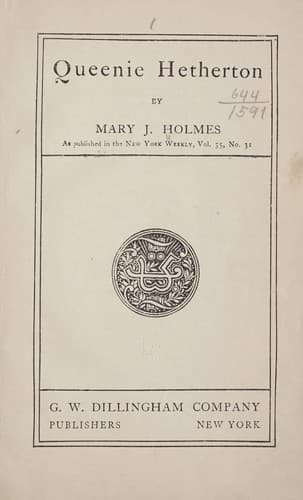
American fiction -- 19th century; Dime novels; Man-woman relationships -- Fiction; Upper class -- Fiction
“Christine, you did not like my father. I see that in all you say, but
he was very dear to me, and I loved him so much! You were prejudiced
against him, but I insist upon your going on just the same and telling
me everything. Why did she not have his society? Where and how did he
pass his time, if not with her? He loved her, I am sure. You know he
did. You know he loved my mother.”
She kept asserting this, for there was an expression on Mrs. La Rue’s
face which she could not understand and which did not quite please her.
“He was very proud of her beauty, and in his way fond of her, but I do
not think it was in Monsieur Hetherton’s nature to love any one long.
Her habits did not suit him; his did not suit her; she breakfasted at
nine; he breakfasted at eleven in his room, and frequently dined out,
returning generally to see her dressed for the opera or concert, and
dictating about her toilet until we were both at our wits’ end. Her
tastes were too simple for him. He wished her to wear velvet and satin,
and diamonds and pearls, while she would have liked plain muslin gowns
and a quiet home in the country, with hens, and chickens, and pets. She
was very happy at Chateau des Fleurs, and would have been happier if
monsieur had staid more with her, but he was much in Paris, and
Switzerland, and Nice, and so we were alone a great deal, and she taught
me many things and was very kind to me.”
“But why did not my father stay with her more?” Reinette asked, and Mrs.
La Rue replied: “He was fond of travel, and hunting, and racing, and had
many gentlemen friends there, whose influence was not good, and he
complained that Chateau des Fleurs was lonely. If he only had a child—a
son—he could bear it, he said; but as it was, the place was unendurable,
and so he staid away weeks at a time, while your mother pined and
drooped like some fair lily which had neither water nor sunshine.”
“Oh, this is very dreadful,” Queenie said, with a choking sob. “I am
glad grandma will never know what you have told me. But go on and tell
me the rest. I insist upon knowing the whole.”
So Mrs. La Rue told of the weeks and weeks which her mistress passed
alone at Chateau des Fleurs, while Mr. Hetherton was seeking his
pleasure elsewhere; of his great desire for a son to bear his name; of
Mrs. Hetherton’s failing health and removal at last to Southern France,
and then, as the season advanced, to Rome; of the great joy which came
to her so unexpectedly and which she purposely kept from her husband,
wishing to surprise him when he joined her in Rome, as he promised to
do; of the weary weeks of waiting, hoping against hope, for he was
always coming in a few days at the most and never came; and then of a
girl baby’s birth sooner than it was expected, and the scene which
followed, when the young wife died, with her little girl clasped to her
bosom and her own head pillowed on Christine’s arm.
Public-domain text, read in full here on John Shaqi.
Reviews
Reviews
No reviews yet
Be the first to share your thoughts on this work.
Elsewhere in the archive
Join the Discussion
Join the discussion
Sign in to leave a comment or review.
Sign InorCreate an account