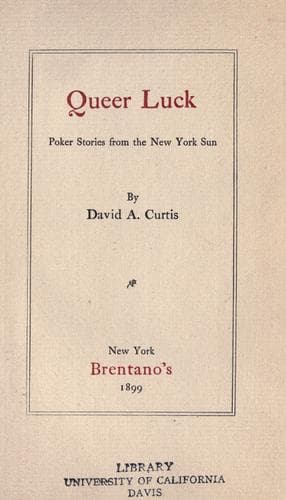
Queer Luck: Poker Stories from the New York SunCurtis, David A.
General
Queer Luck: Poker Stories from the New York Sun
Curtis, David A.
Poker -- Fiction; Poker players -- Fiction; Short stories, American
“Oh! forget it,” said the man with his heels on the fender. “Excuse
me,” he added, as the other looked at him in mild surprise, “but that
is such an awful chestnut. What has provoked you to philosophizing?”
“Was I philosophizing? Well, perhaps I was. One of the youngsters asked
me to join in a game of poker a little while ago, and I was going to
do it, for I like poker when the stakes are not too heavy, but he told
me they were playing with a joker.
“Now, they may get up a game of poker one of these days with high, low,
big and little casino, and the right and left bowers in it, and it
may prove to be a game that will be much liked by those who play it.
Certainly, I will have nothing against it. But when I sit in at the
game I want to play it as I learned it. So I declined the invitation.”
“Do you play it as you learned it?” asked the other. “When I learned,
four aces couldn’t be beaten.”
“I must admit that point to be well taken,” said the gray-haired
young-looking man, “for I can remember, myself, when a straight flush
was an unknown hand. In fact, the first one I ever saw came near
costing two lives. But the straight flush, though it was in its day
a modern improvement, was a legitimate development and not a change
in the game. The principle underlying draw poker is that a hand is
valuable exactly in proportion to the difficulty encountered in getting
it--that is, according to the smallness of the chance you have of
holding it. Fours were supposed to be the hand that was the hardest to
get, and so fours were the winning hand. When somebody discovered that
the chances of holding a straight flush were fewer than the chances of
holding fours, the straight flush took its place strictly in accordance
with the rules of the game as already formulated. The only reason it
was not played from the first was that it had not been recognized as a
distinct hand before. If somebody should discover a new hand--that is,
a new combination of cards with a positive, individual character of its
own, sharply distinguishing it from any other combination--that new
hand might be admitted at its proper value without changing the rules.”
“There is a certain amount of interest in what you say, no doubt,” said
the man with his heels on the fender, “but it occurs to me that there
may be even more in the narration of the circumstances under which you
made the acquaintance of a straight flush.”
Public-domain text, read in full here on John Shaqi.
Reviews
Reviews
No reviews yet
Be the first to share your thoughts on this work.
Join the Discussion
Join the discussion
Sign in to leave a comment or review.
Sign InorCreate an account