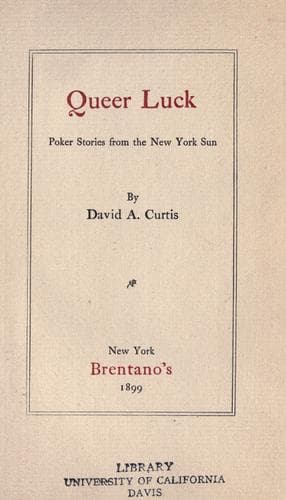
Queer Luck: Poker Stories from the New York SunCurtis, David A.
General
Queer Luck: Poker Stories from the New York Sun
Curtis, David A.
Poker -- Fiction; Poker players -- Fiction; Short stories, American
“Now a ‘blaze,’” continued the other, “is certainly a distinct hand,
but it seems to be a characterless sort of a thing, and not entitled
to much respect. And the same may be said of the alternated straight.
It is true that an effort was made to introduce the blaze, but it
didn’t meet with much favor. I don’t think it is played anywhere now,
and I never heard of anybody seriously proposing to play alternated
straights. Come to think of it, the straight was not a part of the old
original game, and was not universally played until within a few years.
I don’t imagine, though I never figured on it, that it is any harder
to get than an alternated straight, but it has a stronger character of
its own. That proves what I said, doesn’t it?”
“About those two lives,” said the other, lazily moving his heels a
little further apart.
“It was up in the pine woods of Minnesota. I went there one winter
to escape a galloping consumption that my doctor predicted, and had
secured a job with Brown & Martin, a firm that had several lumber
camps in the woods. There was a gang of about forty men in our camp,
and there was nothing particularly unusual about them, excepting
perhaps that there was rather more card playing at night than the
bosses liked to have. I don’t know that it is prohibited in any of the
camps--certainly it was not in those days; but gambling is discouraged,
for the men’s sakes as well as for the bosses’, and as a rule there
isn’t much going on.
“The lumbermen are very impatient of restraint, though, and no
intelligent foreman interferes with them much outside of working
hours, and as there were half a dozen men in our camp who were
inveterate gamblers, the infection spread until there were four or
five poker games going on every night. Our foreman was a Yankee from
Maine, a strapping big fellow, who did not play himself, and strongly
disapproved of it, but he had a great amount of discretion, and beyond
speaking his mind freely he did not try to stop it.
“This was thirty years ago, mind you, and, as I said a moment ago,
the straight was not played everywhere. We played it, however, for
there were a good many there who had become familiar with it, and they
insisted on it, and the few who were disposed to grumble at it as a
new-fangled notion submitted, though not with the best grace. If you
remember, the straight, as played then, only beat two pairs. Its value
as the lowest complete hand had not yet been recognized.”
The other man nodded.
“One of the men in the party I usually played with was Will Davison, a
big, overbearing sort of man, who grew sarcastic whenever a straight
was played, and who made it a point to throw down his own hand rather
than draw to a sequence of four, calling attention to what he did.
“‘I have no use for a boy’s game,’ he used to say with a sneer, but the
rest of the party overruled him, and he liked the game too well to stay
out.
Public-domain text, read in full here on John Shaqi.
Reviews
Reviews
No reviews yet
Be the first to share your thoughts on this work.
Join the Discussion
Join the discussion
Sign in to leave a comment or review.
Sign InorCreate an account