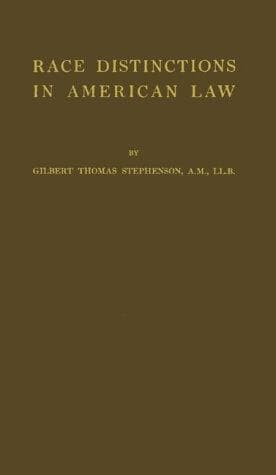
Race Distinctions in American LawStephenson, Gilbert Thomas
History
Race Distinctions in American Law
Stephenson, Gilbert Thomas
African Americans -- Politics and government; Law -- United States -- History; United States -- Race relations
A noticeable effort has been made during the past few years by students
of race relations to construct a platform upon which all men of every
race may stand and work together for the permanent settlement of all
racial antagonisms. This is evidenced by the organization of late years
of national movements which have enlisted the support of men of
different sections and races. One of these, the Southern Education
Association, has been promoted by men from the North and East as well as
by men from the South, by both Negroes and white people. Soon after the
Atlanta riots of two years ago, a conference of Southern white men and
Negroes was held at Atlanta, for the purpose of promoting harmony
between the races in the South. Within a few months a conference of
Northern and Southern white men has met in Washington City to consider
the Negro problem. Still more recently a group of Southern students in
Harvard University, realizing that the race relations were different in
different localities of the South, have organized an informal club to
study the practical problems arising out of the presence of the Negro in
the South and to exchange ideas formed from observation and experience
in their respective localities. There are other indications of a desire
to work out a common set of principles by which everyone may be
governed.
PROPER PLACE OF RACE DISTINCTIONS
Assuming that it is possible to formulate a platform deserving the
approval of all races, it is appropriate for a student of any phase of
race relations to suggest a plank for it. A student in the special field
of race distinctions in American law may endeavor to show the place that
such legal distinctions properly hold, bearing in mind all the while
that the whole issue springs out of race consciousness as it actually
exists to-day, not as it should be or as it may be in the distant
future.
Public-domain text, read in full here on John Shaqi.
Reviews
Reviews
No reviews yet
Be the first to share your thoughts on this work.
Elsewhere in the archive
Join the Discussion
Join the discussion
Sign in to leave a comment or review.
Sign InorCreate an account