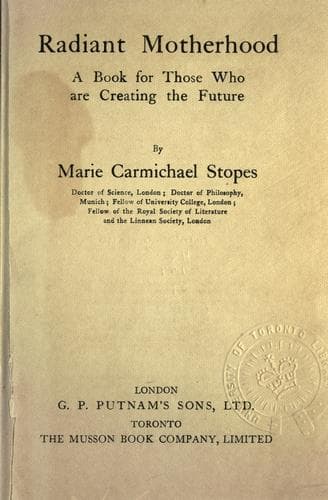
Radiant Motherhood: A Book for Those Who are Creating the FutureStopes, Marie Carmichael
Science
Radiant Motherhood: A Book for Those Who are Creating the Future
Stopes, Marie Carmichael
Mothers
There is an old and in my opinion valuable view (although it has not
been “scientifically proved”) that the actual hour of conception, the
condition of the parents at the moment when the germs fuse is one of
vital consequences to the child-to-be. Scientific proof of this will
be, of course, extraordinarily difficult to discover, but indirectly
there do appear to be some actual data in favour of the converse,
namely that temporary unhealthy states of the parents result in the
conception of children so inferior as to be markedly and seriously
anti-social. Forel (_Sexual Question_, 1908) says:--
The recent researches of Bezzola seem to prove that the old belief
in the bad quality of children conceived during drunkenness is
not without foundation. Relying on the Swiss census of 1900,
in which there figure nine thousand idiots ... this author has
proved that there are two acute annual maximum periods for the
conception of idiots (calculated from nine months before birth)
the periods of carnival and vintage, when the people drink most.
In the wine-growing districts, the maximum conception of idiots at
the time of vintage is enormous, while it is almost _nil_ at other
periods.
It is, of course, not always possible to arrange the hour of the union
which will lead to conception. And further even when the hour of the
union is arranged, nature, to some extent, controls and may modify
conditions before conception. Sometimes the fertilization of the egg
cell by the sperm cell takes place in the hour of the bodily union of
the lovers, sometimes this inner process is delayed by hours or days
(see overleaf). Conception is possible in most women at almost any
time during the years of potential motherhood, yet there do appear to
be several factors which lead to the potential fertility of a woman
varying very much from time to time. Some women, for instance, appear
to be liable to conceive only for a certain number of days in each
month, and these are in general the two or three days immediately
following the monthly period and the day or two immediately before.
With other women, however, unions on any day of the month may lead to
conception, but this depends, possibly, not only on the woman herself
but on the vitality and probable length of life of the sperm cells of
her husband. This also varies very greatly in individuals. The longest
time which the individual sperm has been observed to remain vital after
entry into the woman is seventeen days (see Bossi, _N. Arch. d’Obstetr.
Gynocol._, April 1891).
Hence it will be realized that a union arranged to take place under
ideal and perfect conditions, perhaps on a holiday into wild and
inspiring solitudes, may result as desired in the entry of the sperm
into the womb of the woman, and yet the actual fusion of the sperm and
egg cell, and the consequent conception may not come to pass until some
days later.
Public-domain text, read in full here on John Shaqi.
Reviews
Reviews
No reviews yet
Be the first to share your thoughts on this work.
Join the Discussion
Join the discussion
Sign in to leave a comment or review.
Sign InorCreate an account