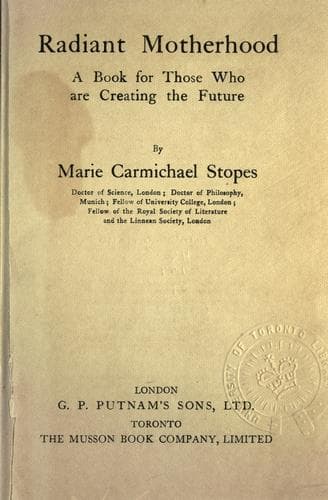
Radiant Motherhood: A Book for Those Who are Creating the Future — John Shaqi
Radiant Motherhood: A Book for Those Who are Creating the FutureStopes, Marie Carmichael
Science
Radiant Motherhood: A Book for Those Who are Creating the Future
Stopes, Marie Carmichael
Mothers
Strange it is indeed in this world, in which so much scientific and
laborious observation has been devoted to all sorts of irrelevant and
trivial subjects, that knowledge of the actual processes of our own
fertilization and conception and of the extent of the significance to
the future generations of the mode and condition of the union of the
parents are almost totally unknown to scientists or doctors, and are
disregarded by the majority of the public.
A recent memoir in the French Academy of Science[1] dealing with
statistical figures (going back in France, at any rate, so far as 1853)
proves that there does seem to be a definite seasonal influence on
the power of conception. Taking the births for the whole year, it is
found they are not equally divided throughout the months, but that a
notable maximum of births is found in February and March for most of
the countries in the northern hemisphere, the actual maximum of births
being from the 15th February to the 15th March, and thus indicating
that the maximum of conceptions took place between the 5th May and the
5th June. Richet quotes Bertillon as having established the fact that
this maximum of conceptions does not depend on the chance that brides
like to be married in the spring, because an identical maximum is found
in the illegitimate birthrate. Richet gives many tables of figures,
and maintains that the maximum corresponds both in the town and in the
country, among the rich and the poor, and among the married and the
unmarried, and is, therefore, in his opinion, an actual physiological
function:--
[1] Charles Richet, “De la Variation mensuelle de la Natalité,” 1916,
Comptes rendus Acad. Sciences, Paris, pp. 141-149 and 161-166.
C’est que les conditions physiologiques de la maturation de l’ovule
et de sa fécondation ne sont pas également favorables dans toutes
les periodes de l’année. Par suite d’une ancestrale prédisposition,
au moment du printemps, chez la femme, comme chez la plupart des
animaux, mais moins nettement que chez eux, la maturation, la chute
et la fécondation de l’ovule se font dans des conditions meilleures
et plus assurées.
The corresponding maximum for the southern hemisphere arises between
August and October. This natural tendency to produce children
according to the season is, to some extent, altered by the conscious
and deliberate control of parenthood, which all the more highly
civilized countries now find that their better citizens are exerting.
Public-domain text, read in full here on John Shaqi.
Reviews
Reviews
No reviews yet
Be the first to share your thoughts on this work.
Join the Discussion
Join the discussion
Sign in to leave a comment or review.
Sign InorCreate an account