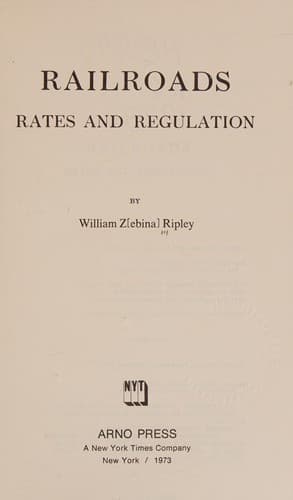
Railroads: Rates and RegulationsRipley, William Zebina
History
Railroads: Rates and Regulations
Ripley, William Zebina
Railroads -- Freight -- Rates -- United States; Railroads and state -- United States
Complexities in rate adjustment often arise from the fact that in
the manufacture of many commodities the marketing of by-products is
of increasing importance. The rate on the whole series of related
commodities must be taken into account at once. Thus in lumbering, a
large amount of waste or very low-grade lumber is necessarily produced.
This common lumber cannot bear long transportation; it must be utilized
locally, if at all. On the other hand, the choicest specialties will
command a price even in remote markets. A monopoly price is enjoyed in
such a case. The Pacific coast lumbermen can market their long timbers
anywhere in the United States; but the demand for the common lumber,
restricted to a sparsely populated region, tends to be exceeded by the
supply.[116] The real competition between the southern, the Michigan,
the Wisconsin and the Pacific coast manufacturers thus narrows down
to the sale of the medium-grade product. And the cost of production
of this is, of course, in part dependent upon the profit made upon
the other two sorts, each of which in its own field appears to be a
monopoly. A wide market and a good price for medium-grade lumber may so
lessen the cost of the cheapest by-products that they in turn may be
so reduced in price as to widen their reach to the consumer. Each rate
reacts upon the others. The situation can be successfully controlled
only by adjusting them all at once.
Not only are rates competitive as between raw materials and the
finished product made from them, but the circle of competition
immediately widens to include all commodities capable of substitution
one for another.[117] Coal rates, of course, are partly determined
by rates on cordwood, and _vice versa_. During the great coal strike
in Pennsylvania in 1903, soft coal rates and hard coal rates were
sadly disturbed. Such substitutions are always likely to occur. But
the conditions are not always so simple as this. An instance in
point is given by a witness before the Senate (Elkins) Committee on
Interstate Commerce in 1905.[118] This shows how a reduction in the
rate for transportation of corn from Kansas to Texas brought about
a corresponding reduction in the rate on flour from Minneapolis to
Chicago. There was a large crop of corn in Kansas; and the Chicago
lines anticipated brisk business in the carriage of this product. The
traffic managers of lines from Kansas to Texas, however, discovered a
large demand for corn in Texas at a price higher than then prevailed
in Kansas. Any rate less than the difference in prices between the
two districts would cause shipments of corn to flow from Kansas to
Texas, just as inevitably as water flows down hill. This rate would
needs be low; but the corn could be loaded on empty southbound cars
which had been used to haul cotton out of Texas to the north. This, of
course, entailed a diversion of corn from the Chicago railways, which
promptly reduced rates in order to hold their traffic. For years the
Public-domain text, read in full here on John Shaqi.
Reviews
Reviews
No reviews yet
Be the first to share your thoughts on this work.
Elsewhere in the archive
Join the Discussion
Join the discussion
Sign in to leave a comment or review.
Sign InorCreate an account