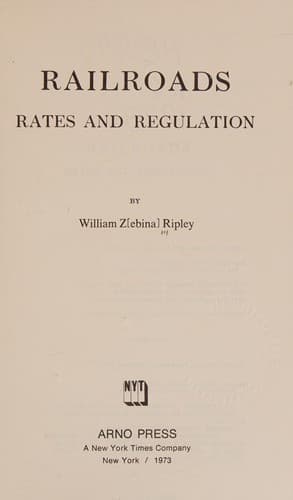
Railroads: Rates and RegulationsRipley, William Zebina
History
Railroads: Rates and Regulations
Ripley, William Zebina
Railroads -- Freight -- Rates -- United States; Railroads and state -- United States
The period from the Revolution down to 1829, when Stephenson's "Rocket"
made its first successful run between Liverpool and Manchester,
attaining a speed of twenty-nine miles per hour, was characterized in
the United States by increasing interest in canals and toll roads as
means of communication. As involving less expenditure of capital, the
highways were naturally developed first. In 1756 the first regular
stage between New York and Philadelphia covered the distance in three
days, soon to be followed by the "Flying Machine," which made it in
two-thirds of that time. Six days were consumed in the stage trip from
New York to Boston. But by 1790 a considerable network of toll roads
covered the northern territory,--systems which, as in Kentucky by 1840,
attained a length of no less than four hundred miles. Post roads linked
up such remote points as St. Louis, New Orleans, Nashville, Charleston,
and Savannah by 1830. Pennsylvania had made an early beginning in 1806;
and by 1822 had subscribed nearly two million dollars to fifty-six
turnpike companies and wellnigh a fifth of that sum toward the
construction of highway bridges. Most of these roads throughout the
country, however, were private enterprises, and, even where aided by
the state governments, were imperfectly built and worse maintained,
disjointed and roundabout.
The need of a comprehensive highway system, especially for the
connection of the coastal belt with the Middle West, early engaged the
attention of Congress. Washington seems to have fully appreciated its
importance. Ten dollars a ton per hundred miles for cost of haulage by
road, necessarily imposed a severe restriction upon the extension of
markets. The Federal Congress in 1802 appropriated one-twentieth of
the proceeds from the sale of Ohio lands to the construction of such
highways. Gallatin's interest in the matter five years later, led to
his proposal of an expenditure of $20,000,000 for the purpose. The
Cumberland Road or "National Pike" was the result. This great highway
started from near the then centre of population in Maryland and cut
across the Middle West, half-way between the lakes and the Ohio river.
From the upper reaches of the Potomac it followed Braddock's Old Road
to Uniontown, Pennsylvania, then by Wheeling over "Zanes trace" to
Zanesville, Ohio. From that point on it trended toward St. Louis by
way of Columbus and Indianapolis, ending at Vandalia, Illinois. During
the space of thirty years about $10,000,000 was expended upon it, and
it undoubtedly did much to promote the settlement of the country. But
the success of canals and railroads in the meantime sapped the vitality
of the movement for further turnpike construction before St. Louis
was reached. By the close of the war of 1812, in fact, it had become
apparent that highways were destined to serve only as feeders after
all; and not as main stems of communication.
Public-domain text, read in full here on John Shaqi.
Reviews
Reviews
No reviews yet
Be the first to share your thoughts on this work.
Join the Discussion
Join the discussion
Sign in to leave a comment or review.
Sign InorCreate an account