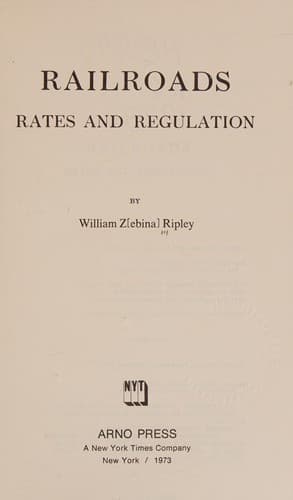
Railroads: Rates and RegulationsRipley, William Zebina
History
Railroads: Rates and Regulations
Ripley, William Zebina
Railroads -- Freight -- Rates -- United States; Railroads and state -- United States
The decades 1870-1880, 18.--Trans-Mississippi
development, 18.--Pacific Coast routes
opened, 19.--Development of export trade in grain and
beef, 20.--Trunk line rate wars, 21.--Improvements in
operation, 23.--End of canal and river traffic, 24.
The decade 1880-1890, 27.--Phenomenal railway
expansion, 28.--Transcontinental trade, 28.--Speculation
rampant, 29.--Growth of western manufactures, 30.--Rise of
the Gulf ports, 31.--Canadian competition, 33.--General
résumé and forecast, 34.
Public land grants, 35.--Direct financial
assistance, 37.--History of state aid, 39.--Federal
experience with transcontinental roads, 40.
The possibility of a unified nation of ninety odd million souls, spread
over a vast territory of three million square miles,--three-fourths
of the area of Europe,--was greatly enhanced at the outset by the
geographical configuration of the continent of North America. It was
fortunate, indeed, that the original thirteen colonies were strictly
hemmed in along the Atlantic seaboard, thus being protected against
premature expansion. At the same time the north and south direction
of this narrow coastal strip, with its variety of climates, soils,
natural resources and products, brought about a degree of intercourse
and mutual reliance of the utmost importance. The mere exchange of the
dried fish and rum of New England, for the sugar, tobacco, molasses
and rice of the southern colonies, paved the way for an acquaintance
and intellectual intercourse necessary to the development of national
spirit. Throughout the colonial period, the protected coast waters and
navigable rivers as far inland as the "fall line," rendered the problem
of long distance transportation relatively easy. For everything went
by water. Population was compelled to develop the country somewhat
intensively, by reason of the difficulty of westward expansion. But
this population after the Revolution began to press more and more
insistently against the mountain barriers; so that the need of purely
artificial means of transportation at right angles to the seaboard
became ever more apparent.
Public-domain text, read in full here on John Shaqi.
Reviews
Reviews
No reviews yet
Be the first to share your thoughts on this work.
Join the Discussion
Join the discussion
Sign in to leave a comment or review.
Sign InorCreate an account