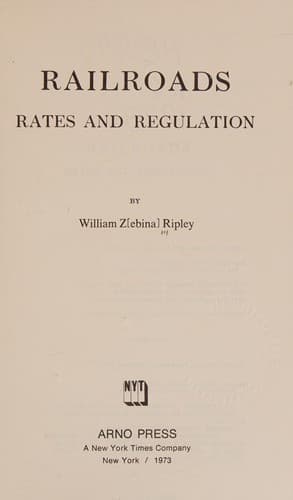
Railroads: Rates and RegulationsRipley, William Zebina
History
Railroads: Rates and Regulations
Ripley, William Zebina
Railroads -- Freight -- Rates -- United States; Railroads and state -- United States
This ruinous diversion of freight seems to have been dependent upon the
existence of active competition at Detroit and ceased when the Grand
Trunk came to an agreement with the American lines. But there can be no
doubt that wherever these cross lines exist there is a strong tendency
toward diversion. In the recent hearings of the Senate Committee on
Interstate Commerce on railway rate regulation, a railroad witness
again describes the operation:
Mr. VINING. Well, for instance, take the time when I was on
the Grand Rapids and Indiana Railroad. Its connection at the
south was at Fort Wayne, with the Pittsburg, Fort Wayne and
Chicago Road. We took lumber out of Michigan and wanted to
send it east. We had to compete with lines that went by way
of Detroit, that went perhaps through Canada and that in some
cases were shorter. Of course, if we wanted to send lumber
from Grand Rapids to New York we had to make at least as low
a rate as was made by other lines leading from Grand Rapids
to New York. That rate might be just the same from Fort Wayne
as from Grand Rapids, so that we could not get any more than
the low rate from Fort Wayne. We had to go in that case to the
Pittsburg, Fort Wayne and Chicago Railway and say: "Here are so
many carloads of lumber, or so much lumber, at Grand Rapids, a
part of which could be shipped to New York if we had through
rates that would enable us to move it. These other lines are
carrying it for 25 cents a hundred pounds to New York. You join
us in a through rate of 25 cents and we can give you some of
that business." ... But if I were with a short line and wanted
to negotiate with a long one, I should try to put my case just
as strongly as possible before the long line. I should say to
them: "We can not take 5 per cent. of a rate of 25 cents. It
would not pay us. You know that; you can see that"; and they,
as business men, would admit it. "Well," I would say, "give us
5 cents a hundred pounds and we will bring the business to you,
and if you do not, we can not afford to do it."
SENATOR CULLOM. I think in some instances they have stated
before us that they gave 25 per cent.
Mr. VINING. They might.[293]
Whenever the cross road was financially embarrassed, the tendency to
diversion was increased. For then, of course, having repudiated fixed
charges, the cross line could accept almost any rate as better than the
loss of the traffic. And that this was in the past almost a chronic
condition in western trunk line territory appears from the fact that
eighteen out of the twenty-two roads cutting the Illinois Central
between Chicago and Cairo have been in the hands of receivers since
1874.[294]
Public-domain text, read in full here on John Shaqi.
Reviews
Reviews
No reviews yet
Be the first to share your thoughts on this work.
Elsewhere in the archive
Join the Discussion
Join the discussion
Sign in to leave a comment or review.
Sign InorCreate an account