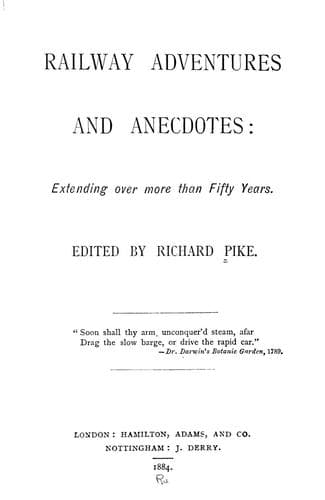
Railway Adventures and Anecdotes: Extending over More Than Fifty Years
History
Railway Adventures and Anecdotes: Extending over More Than Fifty Years
Railroads
,, in Russia 204
,, Improvement in Third-Class 143
Trent Station 192
Trip, An Unpleasant Trial 72
Tunnel, In a Railway 137
Very Cool 199
Waif, An Extraordinary 245
Ward’s, Artemus, Suggestion 197
Watkin, Sir Edward, on Touting for Business 269
Way, A Quick 138
Way-Leaves 13
Wedding at a Railway Station 166
What are you going to do? 189
Whistle, Steam 98
Wolves on a Railway 197
Wordsworth’s Protest 122
Yankee Compensation Case, A 218
ORIGIN OF RAILWAYS
The immediate parent of the railway was the wooden tram-road, which
existed at an early period in colliery districts. Mr. Beaumont, of
Newcastle, is said to have been the first to lay down wooden rails as
long ago as 1630. More than one hundred and forty years elapsed before
the invention was greatly improved. Mr. John Carr, in 1776 (although not
the first to use iron rails), was the first to lay down a cast-iron
railway, nailed to wooden sleepers, for the Duke of Newcastle’s colliery
near Sheffield. This innovation was regarded with great disfavour by the
workpeople as an interference with the vested rights of labour. Mr.
Carr’s life, as a consequence, was in much jeopardy and for four days he
had to conceal himself in a wood to avoid the violence of an indignant
and vindictive populace.
WAY-LEAVES.
Roger North, referring to a visit paid to Newcastle by his brother, the
Lord Keeper Guildford, in 1676, writes:—“Another remarkable thing is
their _way-leaves_; for when men have pieces of ground between the
colliery and the river, they sell the leave to lead coal over the ground,
and so dear that the owner of a rood of ground will expect £20 per annum
for this leave. The manner of the carriage is by laying rails of timber
from the colliery down to the river exactly straight and parallel, and
bulky carts are made with four rowlets fitting these rails, whereby the
carriage is so easy that one horse will draw four or five chaldron of
coals, and is an immense benefit to the coal merchants.”
SIR ISAAC NEWTON’S PREDICTION OF RAILWAY SPEED.
Public-domain text, read in full here on John Shaqi.
Reviews
Reviews
No reviews yet
Be the first to share your thoughts on this work.
Join the Discussion
Join the discussion
Sign in to leave a comment or review.
Sign InorCreate an account