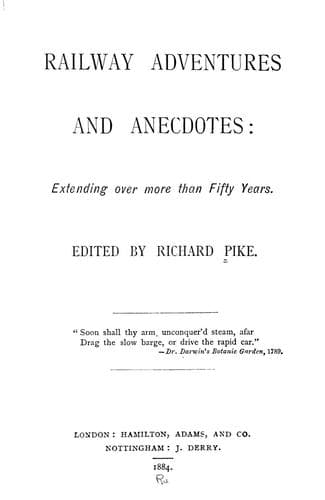
Railway Adventures and Anecdotes: Extending over More Than Fifty Years
History
Railway Adventures and Anecdotes: Extending over More Than Fifty Years
Railroads
In a tract by the Rev. Mr. Craig, Vicar of Leamington, entitled “Astral
Wonders,” is to be found the following remarkable passage:—“Let me
narrate to you an anecdote concerning Sir Isaac Newton and Voltaire. Sir
Isaac wrote a book on the Prophet Daniel, and another on the Revelations;
and he said, in order to fulfil certain prophecies before a certain date
terminated, namely 1260 years, there would be a certain mode of
travelling of which the men in his time had no conception; nay, that the
knowledge of mankind would be so increased that they would be able to
travel at the rate of fifty miles an hour. Voltaire, who did not believe
in the Holy Scriptures, got hold of this, and said, ‘Now look at that
mighty mind of Newton, who discovered gravity, and told us such marvels
for us all to admire, when he became an old man and got into his dotage,
he began to study that book called the Bible; and it appears that in
order to credit its fabulous nonsense, we must believe that mankind’s
knowledge will be so much increased that we shall be able to travel fifty
miles an hour. The poor ‘dotard!’ exclaimed the philosophic infidel,
Voltaire, in the complaisancy of his pity. But who is the dotard now?”
THE ATMOSPHERIC RAILROAD ANTICIPATED.
_First Voice_.
“But why drives on that ship so fast,
Without or wave or wind?”
_Second Voice_.
“The air is cut away before,
And closes from behind.”
—_The Ancient Mariner_.
This is the exact principle of the atmospheric railroad, and it is,
perhaps, worthy of note as a curious fact that such a means of locomotion
should have occurred to Coleridge so long ago.
W. Y. Bernhard Smith, in _Notes and Queries_.
EARLY STEAM CARRIAGES.
Stuart, in his “Historical and Descriptive Anecdotes of Steam Engines and
of their Inventors and Improvers,” gives a description of what was
supposed to be the first model of a steam carriage. The constructor was
a Frenchman named Cugnot, who exhibited it before the Marshal de Saxe in
1763. He afterwards built an engine on the same model at the cost of the
French monarch. But when set in motion it projected itself onward with
such force that it knocked down a wall which stood in its way, and—its
power being considered too great for ordinary use—it was put aside as
being a dangerous machine, and was stowed away in the Arsenal Museum at
Paris. It is now to be seen in the Conservatoire des Arts et Métiers.
Mr. Smiles also remarks that “An American inventor, named Oliver Evans,
was also occupied with the same idea, for, in 1772, he invented a steam
carriage to travel on common roads; and, in 1787, he obtained from the
State of Maryland the exclusive right to make and use steam carriages.
The invention, however, never came into practical use.
Public-domain text, read in full here on John Shaqi.
Reviews
Reviews
No reviews yet
Be the first to share your thoughts on this work.
Join the Discussion
Join the discussion
Sign in to leave a comment or review.
Sign InorCreate an account