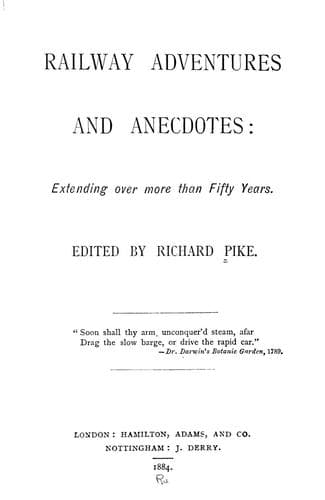
Railway Adventures and Anecdotes: Extending over More Than Fifty Years
History
Railway Adventures and Anecdotes: Extending over More Than Fifty Years
Railroads
“Exactly, you should like to see it made. So you have been led to
petition against it, though you are favourable to it?”
The petitioner against the Bill did not appear to comprehend the precise
drift of the remark, and his only reply to the wordy fix into which the
learned agent had drawn him was made in the dumb-show of scratching with
his one disengaged hand (the other being employed in holding his hat) his
uncombed head—an operation that created much laughter, which was not
damped by the Agent’s putting, with a serious face, a concluding question
or remark to him to the effect that he presumed he (the witness) had not
paid, or engaged to pay, so many guineas a day to his friend on the other
side for the prosecution of the opposition against the Bill—had he; yes,
or no? The witness’s appearance was the only and best answer.
The petition, of course, upon this _exposé_, was withdrawn.
This, the substance of what actually took place before one of the
Sub-Committees on Standing orders will give some idea of the nature of
many of the petitions against Railway Bills, especially on technical
points. It will serve to show in some measure what heartless mockeries
these petitions mostly are; the moral evils they give birth to—and that,
even while complaining of errors, they are themselves made up of
falsehood.
AN IDEA ON RAILWAYS.
A happy comment on the annihilation of time and space by locomotive
agency, is as follows:—A little child who rode fifty miles in a railway
train, and then took a coach to her uncle’s house, some five miles
further, was asked on her arrival if she came by the cars. “We came a
little way in the cars, and all the rest of the way in a carriage.”
BURNING THE ROAD CLEAR.
It is related of Colonel Thomas A. Scott, that on one occasion, when
making one of his swift trips over the American lines under his control,
his train was stopped by the wreck of a goods train. There was a dozen
heavily loaded covered trucks piled up on the road, and it would take a
long time to get help from the nearest accessible point, and probably
hours more to get the track cleared by mere force of labour. He surveyed
the difficulty, made a rough calculation of the cost of a total
destruction of the freight, and promptly made up his mind to burn the
road clear. By the time the relief train came the flames had done their
work and nothing remained but to patch up a few injuries done to the
track so as to enable him to pursue his way.
HARSH TREATMENT OF A MAN OF COLOUR.
Public-domain text, read in full here on John Shaqi.
Reviews
Reviews
No reviews yet
Be the first to share your thoughts on this work.
Elsewhere in the archive
Join the Discussion
Join the discussion
Sign in to leave a comment or review.
Sign InorCreate an account