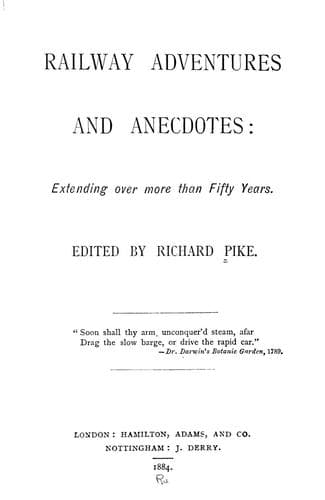
Railway Adventures and Anecdotes: Extending over More Than Fifty Years
History
Railway Adventures and Anecdotes: Extending over More Than Fifty Years
Railroads
My treatment in the use of public conveyances about these times was
extremely rough, especially on “The Eastern Railroad,” from Boston to
Portland. On the road, as on many others, there was a mean, dirty, and
uncomfortable car set apart for coloured travellers, called the “Jim
Crow” car. Regarding this as the fruit of slaveholding prejudice, and
being determined to fight the spirit of slavery wherever I might find it,
I resolved to avoid this car, though it sometimes required some courage
to do so. The coloured people generally accepted the situation, and
complained of me as making matters worse rather than better, by refusing
to submit to this proscription. I, however, persisted, and sometimes was
soundly beaten by the conductor and brakeman. On one occasion, six of
these “fellows of the baser sort,” under the direction of the conductor,
set out to eject me from my seat. As usual, I had purchased a
first-class ticket, and paid the required sum for it, and on the
requirement of the conductor to leave, refused to do so, when he called
on these men “to snake me out.” They attempted to obey with an air which
plainly told me they relished the job. They, however, found me _much
attached_ to my seat, and in removing me tore away two or three of the
surrounding ones, on which I held with a firm grasp, and did the car no
service in some respects. I was strong and muscular, and the seats were
not then so firmly attached or of as solid make as now. The result was
that Stephen A. Chase, superintendent of the road, ordered all passenger
trains to pass through Lynn, where I then lived, without stopping. This
was a great inconvenience to the people, large numbers of whom did
business in Boston, and at other points of the road. Led on, however, by
James N. Buffum, Jonathon Buffum, Christopher Robinson, William Bassett,
and others, the people of Lynn stood bravely by me, and denounced the
railway management in emphatic terms. Mr. Chase made reply that a
railroad corporation was neither a religious nor a reformatory body; and
that the road was run for the accommodation of the public; and that it
required the exclusion of the coloured people from its cars. With an air
of triumph he told us that we ought not to expect a railroad company to
be better than the Evangelical Church, and that until the churches
abolished the “negro pew,” we ought not to expect the railroad company to
abolish the negro car. This argument was certainly good enough as
against the Church, but good for nothing as against the demands of
justice and equity. My old and dear friend, J. N. Buffum, made a point
against the company that they “often allowed dogs and monkeys to ride in
first-class cars, and yet excluded a man like Frederick Douglass!” In a
very few years this barbarous practice was put away, and I think there
have been no instances of such exclusion during the past thirty years;
and coloured people now, everywhere in New England, ride upon equal terms
Public-domain text, read in full here on John Shaqi.
Reviews
Reviews
No reviews yet
Be the first to share your thoughts on this work.
Elsewhere in the archive
Join the Discussion
Join the discussion
Sign in to leave a comment or review.
Sign InorCreate an account