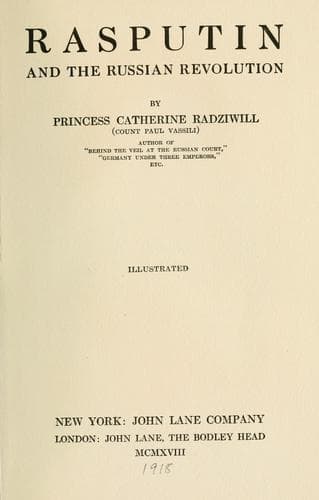
Rasputin and the Russian RevolutionRadziwill, Catherine, Princess
History
Rasputin and the Russian Revolution
Radziwill, Catherine, Princess
Rasputin, Grigorii Efimovich, 1869-1916; Soviet Union -- History -- Revolution, 1917-1921
The former was triumphant. As soon as she became aware of the
conditions under which the German government would consent to conclude
peace with Russia, she set herself, in conjunction with her friends,
to try to persuade Nicholas II. that his duty in regard to his people
required him to put an end to a hopeless conflict during which the best
blood in Russia was being spilt for a cause doomed beforehand. She made
him observe that if the war went on much longer, the revolutionary
elements in the country would wax stronger, in proportion to the
sacrifices entailed upon the nation, and that it was quite possible,
the latter, exasperated by their magnitude, would attempt to get
rid of a government that had not succeeded in restoring to it the
tranquillity which it so sorely needed. It did not take her a long
time to convert the Czar to her point of view, and the negotiations
officiously inaugurated by Mr. Protopopoff were officially continued by
him together with Mr. Sturmer, whom Alexandra Feodorovna personally
entreated to assume their direction in conjunction with her own self.
In spite of the extreme secrecy which had presided at these different
conferences between the Empress and her favourites, something of their
purport had transpired among the general public, and threats had been
proferred against those who had accepted to play the sad part of Judas
in regard to their country. These threats had been whispered in the
corridors of the Duma, and Mr. Protopopoff had been informed of their
purport by his spies. It became therefore one of his principal aims
to get rid of an opposition which, he knew but too well, would only
increase in violence as well as in importance as the sorry work he was
bent upon performing would come out in the light of day and become
known to his numerous adversaries. Apart from this, he thought it
would be better to present himself later on before the Duma with an
accomplished fact behind him. He therefore persuaded the Empress that
whilst he would be pressing with the utmost speed the negotiations
with the Kaiser, begun already, it would be advisable to bring from
the front a considerable number of troops to Petrograd, so as to be
able with their help to crush any effort at resistance attempted either
by the population of the capital or by its garrison, about whose
state of mind the minister did not feel quite sure. The Cabinet was
so badly informed, in spite of its numerous spies, of what was going
on in the army that it imagined the latter would only feel grateful
and happy to see the campaign come to an end and be able to go back
to its homes, and that in consequence it would lend itself with the
greatest pleasure to any attempt made by the Monarch and the government
to put an end to a struggle for which it did not feel any longer any
enthusiasm at heart.
Public-domain text, read in full here on John Shaqi.
Reviews
Reviews
No reviews yet
Be the first to share your thoughts on this work.
Elsewhere in the archive
Join the Discussion
Join the discussion
Sign in to leave a comment or review.
Sign InorCreate an account