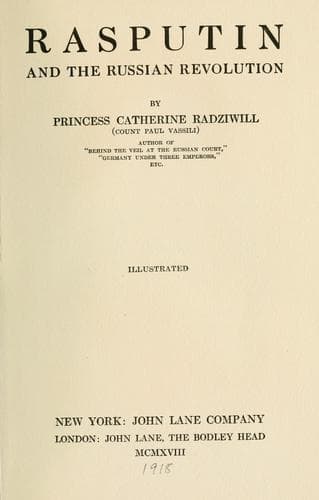
Rasputin and the Russian RevolutionRadziwill, Catherine, Princess
History
Rasputin and the Russian Revolution
Radziwill, Catherine, Princess
Rasputin, Grigorii Efimovich, 1869-1916; Soviet Union -- History -- Revolution, 1917-1921
The men who reasoned thus were absolutely mistaken. The army had made
up its mind to win the war; the workmen whose importance was increasing
with every day that went by, also wished it, because they hoped that
out of this victory they were longing for might result a radical change
in the form of the administration they had begun to despise more and
more as its incapacity became more and more apparent. The person of
the Czar did not inspire respect or enthusiasm any longer, but on the
other hand love for the Fatherland had made considerable progress
since the beginning of the war, and the national sentiment which, up
to that time, had only existed in the state of an Utopia had become a
reality, especially since one had perceived the great strength which it
had communicated to Russia’s allies, to France among others, where the
Republic, which many people were already seeing loom in the distance as
a possibility in the land of the Czars, had inspired so much patriotism
to its citizens.
Neither Mr. Sturmer, nor Mr. Protopopoff, nor those who shared their
opinions and their views, were able to understand what was going on
in the heart and in the soul of the Russian nation. They were far
too much absorbed in their own petty, personal interests, to be able
to give a thought to such a subject. For them the conclusion of a
peace with Germany meant the strengthening of their influence and of
their power, together with honours, dignities, and the possibility
to enrich themselves, and to have a few more stars attached to the
golden embroideries of their uniforms. It meant also the possibility
of getting rid once for all of this spectre of a responsible ministry,
of which they stood in such dread. They therefore threw themselves in
the struggle against the Duma with an ardour that grew as they saw the
increasing difficulties with which the accomplishment of their designs
was going to encounter in that Assembly, and, as a first step in the
course of action they had determined to follow, they submitted to the
signature of Nicholas II. the fatal decree which prorogued the Duma
together with the Council of State, and which was to give the signal
for the conflagration of which they were to become themselves the first
victims.
Traitors are always to be found in hours of great national peril. Among
the people who resided in the palace of Tsarskoie Selo, there was a
person who, becoming acquainted by chance of what was going on there,
rushed to communicate the news which he had heard to Mr. Kerensky, the
leader of the extreme left party in the Duma. The latter did not lose
one moment in communicating to his colleague the news which had come to
his knowledge, and also to the president of the Assembly, Mr. Rodzianko.
[Illustration:
_Photograph, International Film Service, Inc._
ALEXANDER KERENSKY]
Public-domain text, read in full here on John Shaqi.
Reviews
Reviews
No reviews yet
Be the first to share your thoughts on this work.
Elsewhere in the archive
Join the Discussion
Join the discussion
Sign in to leave a comment or review.
Sign InorCreate an account