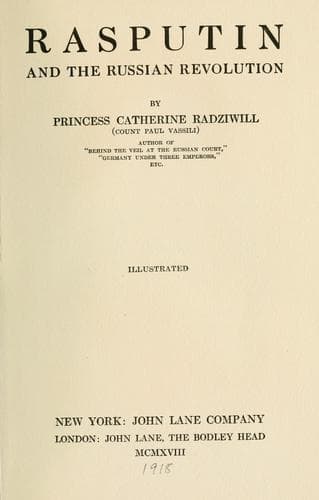
Rasputin and the Russian RevolutionRadziwill, Catherine, Princess
History
Rasputin and the Russian Revolution
Radziwill, Catherine, Princess
Rasputin, Grigorii Efimovich, 1869-1916; Soviet Union -- History -- Revolution, 1917-1921
At ten o’clock in the evening of that same day, the 15th of March, they
reached Pskov. Their intention had been to confer at first with General
Roussky, but an Imperial aide de camp met them on the platform, and
asked them to follow him immediately into the presence of Nicholas
II. The latter received them in his railway carriage. With him were
old Count Fredericks, the Minister of his household, and a favourite
aide de camp, General Narischkine. Nothing in the appearance of the
Emperor could have led any one to suppose that something extraordinary
was happening to him. He was as impassible as was his wont in all the
important occasions of his life, and he shook hands with the delegates
as if nothing whatever was the matter, asking them to sit down. He
motioned Goutschkoff to a chair beside him, and Schoulguine opposite.
Fredericks and Narischkine stood at some distance from the group, and
Roussky, who came in uninvited at that moment, placed himself next to
Schoulguine.
Goutschkoff was the first one to speak. He was extremely agitated
and could only control his feelings with difficulty, keeping his
eyes riveted on the table and not daring to lift them up to the face
of the Sovereign whose crown he had come to demand. But his speech
was perfectly correct, and contained nothing that could have been
interpreted in an offensive way. He exposed the whole situation, such
as it was, and concluded by saying that the only possible manner to
come out of it would be the abdication of the Czar in favour of his
son under the regency of the former’s brother, the Grand Duke Michael
Alexandrovitsch.
At this juncture Roussky could not restrain his impatience, and,
bending down towards Schoulguine, murmured in his ear: “This is already
quite settled.”
When Goutschkoff had finished his speech, Nicholas II. replied in a
perfectly quiet and composed tone of voice:
“I thought the matter over yesterday, and to-day, and I have made up my
mind to abdicate. Until three o’clock I was ready to do so in favour of
my son, but then I came to the conclusion that I could not part from
him.”
He stopped for a few moments, then went on:
“I hope that you will understand this,” and after another pause he
continued:
“On that account, I have decided to abdicate in favour of my brother.”
Public-domain text, read in full here on John Shaqi.
Reviews
Reviews
No reviews yet
Be the first to share your thoughts on this work.
Elsewhere in the archive
Join the Discussion
Join the discussion
Sign in to leave a comment or review.
Sign InorCreate an account