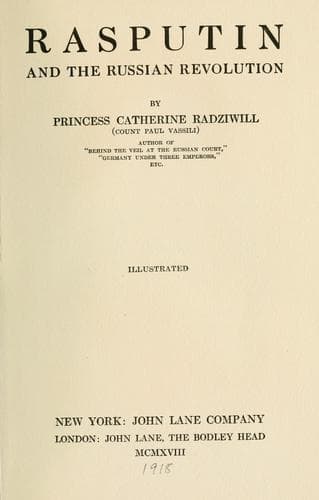
Rasputin and the Russian RevolutionRadziwill, Catherine, Princess
History
Rasputin and the Russian Revolution
Radziwill, Catherine, Princess
Rasputin, Grigorii Efimovich, 1869-1916; Soviet Union -- History -- Revolution, 1917-1921
The delegates looked at each other, and Schoulguine remarked that they
were not prepared for this complication, and that he begged permission
to consult with his colleague. But after a short conversation they
gave up the point, as Goutschkoff remarked that he did not think they
had the right to mix themselves up in a matter where paternal feelings
and affection came into question, and that besides a regency had also
much to say against it, and was likely to lead to complications. The
Emperor seemed satisfied that the delegates had conceded the point, and
then he asked them whether they could undertake to guarantee that his
abdication would pacify the country and not lead to any disturbances.
They declared that they could do so. Upon this he got up and passed
into another compartment of his railway carriage. In about half an hour
he returned, holding in his hand a folded paper, which he handed over
to Goutschkoff, saying as he did so: “Here is my abdication, will you
read it?” After which he shook hands with the delegates and retired as
if nothing unusual had happened, perhaps not realising that with one
stroke of his pen he had changed not only his own life, but the course
of Russian history, and, in a certain sense, destroyed the work of his
glorious ancestor, Peter the Great.
It is difficult here not to make some remark on the part played by
General Roussky in this tragedy which without his interference would
probably have taken a different course. It is impossible not to come to
the conclusion that the unfortunate Czar whom he induced to abdicate,
might have found better and more faithful servants than the people who
forsook him in the hour of his peril. Very probably Roussky believed
that he was acting in the interests of his country, which in a sense
he was also doing, because something had to be attempted in order to
stop the nefarious work of Alexandra Feodorovna, and it is certain
that her husband would never willingly have consented to be parted
from her. Killing a woman would have been disgracing oneself, together
with the Revolution which had been accomplished under such exceptional
circumstances; but still one would have preferred that the man who was
instrumental in the destruction of the Romanoff dynasty should not have
been one who wore on his epaulettes the initials of the Sovereign he
was helping to dethrone. One would have liked him to feel some pity for
the master whose hand he had kissed a few days before he presented to
him the pen with which he ordered him to sign his own degradation. In
spite of the impassibility preserved by Nicholas II. during the last
hours of his reign, it is likely that the tragedy which took place at
Pskov must have been one of the most poignant that has ever assailed
a Sovereign, who, after having reigned for twenty-two years, found
himself, in the course of a few hours, reduced to utter powerlessness
and compelled to give up of his own accord the crown which his father
Public-domain text, read in full here on John Shaqi.
Reviews
Reviews
No reviews yet
Be the first to share your thoughts on this work.
Elsewhere in the archive
Join the Discussion
Join the discussion
Sign in to leave a comment or review.
Sign InorCreate an account