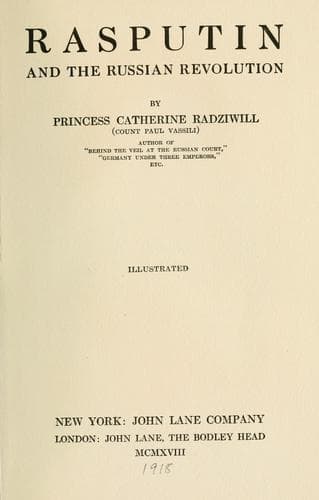
Rasputin and the Russian RevolutionRadziwill, Catherine, Princess
History
Rasputin and the Russian Revolution
Radziwill, Catherine, Princess
Rasputin, Grigorii Efimovich, 1869-1916; Soviet Union -- History -- Revolution, 1917-1921
had but a hazy idea; of the art of government he understood nothing. He
believed in the value of words, and imagined that he could establish
in Russia an ideal State, living upon ideal principles. But at
one time he was popular, and people thought him a strong man, whilst
he was only an eloquent demagogue. With this he had an overbearing
character, would not admit contradiction, and soon was at variance with
his colleagues in the ministry, who, unfortunately for Russia, were
as weak as he was himself but with less tyrannical dispositions; they
retired when they found that they could not prevent him from carrying
out his plans of reforming the army and of abolishing its military
discipline, without which no troops in the world could be expected
to stand bravely in presence of an attacking foe. It is a thousand
pities that men like Paul Milyukoff, Prince George Lvoff, Rodzianko
and others, to whose initiative was due the success of the Revolution,
allowed themselves to be overruled by Kerensky, until he was left alone
to bear upon his shoulders the whole burden of the government and the
whole responsibility of the war, when he collapsed like a weak reed at
the first real attack directed against him.
[Illustration:
_Copyright, Underwood & Underwood, N. Y._
KERENSKY INSPIRING TROOPS TO SUPPORT REVOLUTIONARY GOVERNMENT]
Another misfortune connected with the government that replaced that
of Nicholas II. was that it failed to recognise the terrible German
propaganda that was carried on with renewed energy in Russia after the
Revolution. It would not believe in its danger, and it could not bring
itself to employ violence to put an end to the Socialist or, rather,
anarchist agitation fomented by German intrigues and kept up by German
money, which alone has rendered possible the triumph of Bolschevikism
and the seizure of supreme power by people such as Lenine, Trotzky,
Kameneff, and other personalities of the same kind, and the same
doubtful or, rather, not doubtful reputation.
Public-domain text, read in full here on John Shaqi.
Reviews
Reviews
No reviews yet
Be the first to share your thoughts on this work.
Elsewhere in the archive
Join the Discussion
Join the discussion
Sign in to leave a comment or review.
Sign InorCreate an account