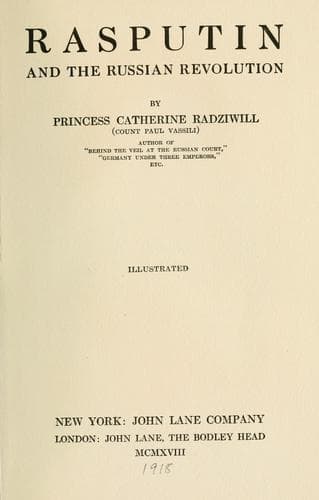
Rasputin and the Russian RevolutionRadziwill, Catherine, Princess
History
Rasputin and the Russian Revolution
Radziwill, Catherine, Princess
Rasputin, Grigorii Efimovich, 1869-1916; Soviet Union -- History -- Revolution, 1917-1921
And yet it would have been relatively easy to put an end to the career
of these men, had one only applied oneself to do so in time and
bravely faced the criticisms of the people who were in their pay, or
in their employ. The whole story of the Lenine-Trotzky intrigue has
not yet been told, at least not here in America; and it may not be
without interest to disclose some of its details. When Milyukoff and
Prince Lvoff proceeded to form a government after the overthrow of the
Monarchy, they offered the portfolio of Justice to a Moscow lawyer
called Karensky (nothing to do with Alexander Kerensky) who enjoyed the
reputation of being one of the most eloquent, and, at the same time,
honest members of the Moscow Bar. They called him to Petrograd, where
they held several consultations with him. Karensky declared himself
ready to accept the position offered him, but only on one condition:
that he would be given an absolutely free hand to proceed with the
greatest energy and vigour against all the German spies and agents with
which the Capital was infested, and that he would also be allowed the
same free hand in his dealings with the anarchists who were beginning
to make themselves heard. Neither Prince Lvoff nor Milyukoff would
agree to give him these powers he demanded. They feared that if they
did so they would be reproached for doing exactly the same as the
government that had crumbled down a few days before; and they also
objected to allowing a member of the cabinet to dispose at his will and
fancy of such grave questions as those involved in repression exercised
against any political party, no matter of what shade or opinion.
Karensky thereupon refused the position offered to him, but accepted
the post of State Prosecutor under Alexander Kerensky at first, and,
afterwards, when the latter had been transferred to the war office,
under Mr. Pereviazeff. This allowed him to watch the growing German
agitation, connected with anarchist conspiracies, which was beginning
to feel its way previous to its explosion. He had heard about Lenine
and Trotzky, and was from the first convinced that they were both in
the employ of the Kaiser either directly or indirectly, and he set
himself to obtain proof that such was the case. He had wondered at
the easiness with which Lenine had been able to obtain a passport
from the German government authorising him to cross the dominions of
William II. on his way from Switzerland to Russia. He, therefore, had
the correspondence of both Lenine and Trotzky watched, and very soon
his attention was attracted by the fact that they were both sending
and receiving constantly telegrams to and from Sweden and Finland, all
of which were deeply concerned with the health of a certain “Kola”
who seemed to be always getting ill, and then better, in a sort of
regular way which appeared more than strange. This was the first remark
which led to the result that at last, it was established, to the
Public-domain text, read in full here on John Shaqi.
Reviews
Reviews
No reviews yet
Be the first to share your thoughts on this work.
Elsewhere in the archive
Join the Discussion
Join the discussion
Sign in to leave a comment or review.
Sign InorCreate an account