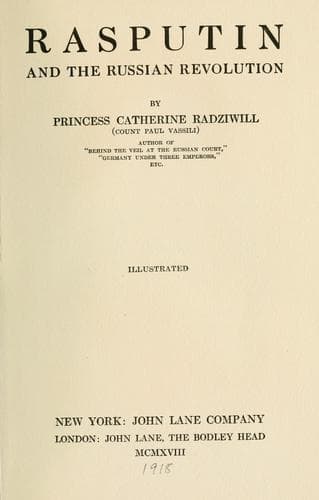
Rasputin and the Russian RevolutionRadziwill, Catherine, Princess
History
Rasputin and the Russian Revolution
Radziwill, Catherine, Princess
Rasputin, Grigorii Efimovich, 1869-1916; Soviet Union -- History -- Revolution, 1917-1921
absolute satisfaction of Karensky and of others, that Trotzky, Lenine,
Kameneff, a certain Zinovieff, a lawyer called Kozlovsky, a lady going
by the name of Madame Soumentay, and the wife of Lenine, had received
not less than _nineteen millions of rubles_ from the German government.
This money had been sent through so many different channels that it was
next to impossible to discover its origin. It had passed through eight
banks, and, I do not now remember, through how many private hands. But
the people whose names I have just mentioned had received it, partly
in Russian banknotes, and partly in banknotes printed in Berlin, which
were supposed to be Russian, of a new type with which the German
government was beginning to meet its obligations so as not to make them
too heavy for its own Exchequer.
Karensky sought Prince Lvoff, who was still Prime Minister at the time,
and asked him to sign an order for the arrest of Trotzky and Lenine.
The Prince had not the courage to do so, and the State Prosecutor had,
perforce, to wait. But in July the first insurrectionary movement,
engineered by the Bolscheviki, broke out, and then Karensky thought
that his duty obliged him to assume the responsibilities which the
ministry did not care to face. By that time Prince Lvoff, Milyukoff
and others had resigned, and Kerensky was virtually master of the
situation. But he was weak, weaker perhaps than any of his colleagues
had been, and he openly declared to the State Prosecutor that he felt
afraid to arrest the two men who were ultimately to lead Russia to
her destruction. Karensky, however, was made of sterner stuff, and he
bravely decided to act for himself, and signed alone the order for
the incarceration of both Lenine and Trotzky. But the former had been
warned, and had fled to Finland. A thorough search was made of the flat
which he occupied, where the sum of one million and a half of rubles
was found in possession of his wife, who could not explain whence she
had this money. Trotzky at the same time was incarcerated and brought
before the State Prosecutor. The latter, in order to justify the course
of action he had taken, had caused to be published in all the Petrograd
and Moscow newspapers an account of the discoveries which he had made,
together with the names of the people who had participated in the work
of treason he was determined to suppress. A curious thing in the story
is that none of the papers that printed it (and they all did with the
exception of the Bolschevik organ _Prawda_), was allowed to get abroad,
which accounts for the fact of no publicity having been given to the
story. Petrograd then was exasperated against Trotzky to such an extent
that Karensky feared he would be lynched, and caused him to be conveyed
to the prison called “Kresty” in an automobile driven by his own son,
as no chauffeur would undertake to drive him there. What happened
later on remains to this day a mystery. The Minister of Justice, Mr.
Public-domain text, read in full here on John Shaqi.
Reviews
Reviews
No reviews yet
Be the first to share your thoughts on this work.
Elsewhere in the archive
Join the Discussion
Join the discussion
Sign in to leave a comment or review.
Sign InorCreate an account