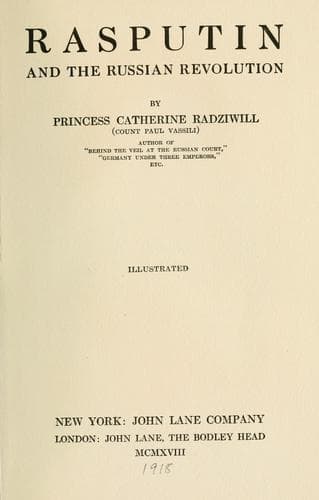
Rasputin and the Russian RevolutionRadziwill, Catherine, Princess
History
Rasputin and the Russian Revolution
Radziwill, Catherine, Princess
Rasputin, Grigorii Efimovich, 1869-1916; Soviet Union -- History -- Revolution, 1917-1921
Pereviazeff, resigned his functions two days after the arrest of
Trotzky, and his place was taken by Nekrassoff, who, when asked by
the Committees of soldiers and peasants who had begun by that time to
be all powerful, to give the reasons which had induced the government
to resort to this measure, became so embarrassed in his replies that
these Committees insisted on Trotzky being set at liberty, which was
done three days afterwards. Karensky then resigned his functions, and
returned to Moscow whence, however, he was obliged to fly and seek a
refuge in Kharkov, as soon as the Bolscheviki seized the government.
The latter inaugurated a system of terrorism that claimed more victims
than is known abroad, completed the disorganisation of the army, and
at last started the negotiations which culminated in the shameful
peace signed at Brest Litovsk. After three and a half years’ war and a
Revolution, Russia as an independent nation ceased to exist, and became
virtually, and to all appearance, a German province.
[Illustration:
_Copyright, International Film Service, Inc._
PEACE DOCUMENT OF DELEGATES AT BREST-LITOVSK CONFERENCE]
This is the story as it reads, and sad enough it sounds. Germany can
look triumphantly on the success of her work and glory in it. Happily
for Russia, for the world and for the cause of civilisation, it is only
one chapter of it that has come to an end. Russia, the great Russia
of the past, is not dead. She possesses far more vitality than she is
given credit for, and she still has sound, true, and honest elements
amidst her citizens. When attempting to judge her, one ought to think
of the great French Revolution, and to remember that in France, also,
it took years before its work was at last consolidated and set upon a
sound basis. One must bear in mind that in France, too, a period of
terrorism made people despair of the future and fear that the end of
their Fatherland had come. Our Russian Revolution is hardly one year
old, and though perhaps one will be aghast at what I am going to
say, I think that she has not yet passed through that phase of real
terror which is always a symptom of great upheavals such as Russia
has undergone and is undergoing. We may see worse things yet; we may
live to look upon the erection of a scaffold on one of the squares of
Petrograd or of Moscow. But this will not mean that the end of Russia
has come, nor that she has become, or will remain, a German province.
The hatred of the Teuton, on the contrary, will grow as events progress
and the great disillusion arrives. A few more months, and the peasants
whom Trotzky, Lenine and their crew have lured with false promises will
perceive that these demagogues have been unable to fulfil all that they
had sworn to them they would do. They will realise that their lot has
become under the rule of these new masters ten thousand times harder
than was the case before, and they will be the first to rise against
these deceivers.
Public-domain text, read in full here on John Shaqi.
Reviews
Reviews
No reviews yet
Be the first to share your thoughts on this work.
Elsewhere in the archive
Join the Discussion
Join the discussion
Sign in to leave a comment or review.
Sign InorCreate an account