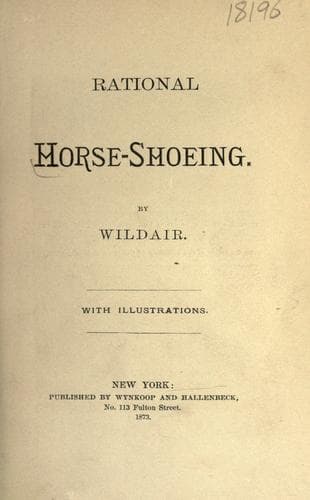
Rational Horse-ShoeingRussell, John E. (John Edwards)
Science
Rational Horse-Shoeing
Russell, John E. (John Edwards)
Horseshoeing
A horse-shoe that the united voices or the shrewdest and ablest managers
in the country commend--inasmuch as it enables cripples to work,
frequently restores them, and maintains soundness where that quality
exists--need not be recommended on the ground of economy. Such a
horse-shoe could not be dear. But it takes all sorts of people to make a
world, and the pressure to the square inch of mean men is not to be
governed by safety-valves or regulated by gauges. There are too many men
who will use the thing that costs the least outlay, even if it tortures
or kills the horse. On the point of first cost we may say that if our
shoe had no advantage over the hand-made shoe in preserving the natural
action and growth of the foot, thereby retaining the powers of the
animal in full vigor, it would still be cheaper than the common shoe. It
is sold slightly higher than the clumsy pieces of bent iron called
horse-shoes by mere courtesy, and its lightness gives one-third more
shoes to the keg, while there is no expense of calking, which, in labor
and material, is equal to three cents per pound. Upon the point of
durability, it is well settled that the heavy shoe will not last so long
as the light one with frog-pressure. A horse set upon heavy shoes grinds
iron every time he moves. The least interposition of the frog will
reduce the wear very materially, and if the frog is well on the ground,
a horse will carry a shoe until he outgrows it.
A horse-railroad superintendent said to the writer, "We don't wear iron
nowadays, we wear _frog_ and _cobble-stones_; nature provides frog and
Boston finds cobble-stones." When the Goodenough shoe is put for the
first time upon a dry, half-dead foot, and the frog brought into lively
action, growth is generally very rapid. We have often been compelled to
reset the shoe, cutting down the wall, in ten days after shoeing. Many
horses that have been used upon pavements and horse-railroads, have
acquired a habit of slipping and sliding along, catching with heel-calks
in the space between the stones; such horses do not at once relinquish
the habit, and wear their first set of our shoes much more rapidly than
the subsequent set, after they have assumed the natural action of their
feet. But, economical as a light shoe that will long outlast a heavy one
may be, the great saving is in the item of horse-flesh.
The value of the horses employed in the actual labor of the country
reaches a startling sum total.
Public-domain text, read in full here on John Shaqi.
Reviews
Reviews
No reviews yet
Be the first to share your thoughts on this work.
Join the Discussion
Join the discussion
Sign in to leave a comment or review.
Sign InorCreate an account