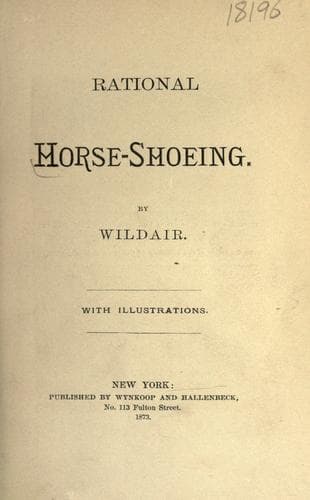
Rational Horse-ShoeingRussell, John E. (John Edwards)
Science
Rational Horse-Shoeing
Russell, John E. (John Edwards)
Horseshoeing
The vast importance of the horse in the movement of business, was never
so fully understood and deeply felt as during the year past, when the
epizootic swept over the continent, paralyzing all movement and every
form of human industry. Even the ships that whiten the seas would furl
their sails and steamers quench their fires but for the labors of the
horse. During the epidemic the canal-boats waited idly for their patient
tow-horses and railroads carried little freight; the crops of the West
lay in the farmers' granaries and the fabrics of the Eastern loom and
varied products of mechanical industry crowded the warehouses; even the
ragpicker in the streets suspended his humble occupation, for the
merchant, unable to transport rags, refused to buy them of the gatherer.
The investment of national wealth in horses being so enormous, any means
that adds to the efficiency of the horse greatly enhances the general
prosperity.
[Illustration: PERFECT SHOE AND HOOF.]
[Illustration: IMPERFECT SHOE AND HOOF.]
It is an old English saying, that "a good horse will wear out two sets
of feet." The meaning of this adage is obvious: a good horse's feet are
useless at the time when his other powers are in the prime. Mr. Edward
Cottam, of London, in his "Observations upon the Goodenough System,"
states that London omnibus-owners use up a young horse in four years;
that is, a horse of seven years of age goes to the knackers at eleven,
_pabulum Acherontis_; and the only noticeable cause of their failure is
from diseases of the feet. A horse properly shod and cared for should
endure five times as long. In this country horses fail in the feet, and
are called old at an age when they should be in the fullest activity.
This is a double loss, for every horseman of experience knows that if an
old horse is sound and vigorous he has some great advantages over a
young one. He is safer in every respect, "way-wise," seasoned, steady,
and reliable. He and his owner are old friends and companions and can
not part but with a pang of regret. A good horse, well cared for, should
work cheerfully until he is thirty years of age; yet how few are able to
perform genteel service after fifteen! It is a sad sight that of the
high-mettled, noble animal, once the petted darling of wealth, caressed
by ladies and children, and guarded so that even the winds of heaven
might not visit him too roughly, fallen through the successive grades of
equine degradation, until at last he hobbles before a clam-wagon or a
swill-cart--a sorry relic of better days.
Public-domain text, read in full here on John Shaqi.
Reviews
Reviews
No reviews yet
Be the first to share your thoughts on this work.
Join the Discussion
Join the discussion
Sign in to leave a comment or review.
Sign InorCreate an account