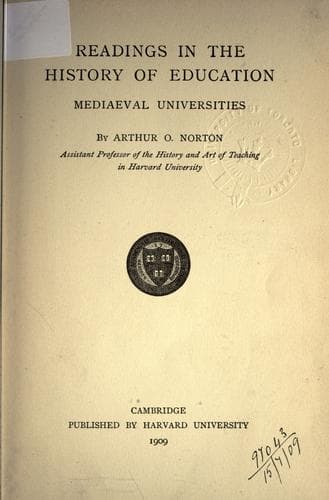
Readings in the History of Education: Mediaeval Universities — John Shaqi
Readings in the History of Education: Mediaeval UniversitiesNorton, Arthur O.
History
Readings in the History of Education: Mediaeval Universities
Norton, Arthur O.
Education, Medieval -- History -- Sources; Universities and colleges -- Europe
Over mountains and over seas the mingled reputation of the city
and the school were carried, and a remarkable stream set in from
Germany, Switzerland, Italy (even from proud Rome), Spain, and
England; even "distant Brittany sent you its animals to be
instructed," wrote Prior Fulques to Abelard (a Breton) a year or
two afterwards.[5]
What was there in the teaching of Abelard which brought together this
extraordinary gathering? One may admit the presence of unanalysable
genius in this master, and still find certain qualities indispensable to
the efficient teacher of to-day,--a winning personality, fulness of
knowledge, and technical skill as a teacher. These are admirably set
forth in the following description:
It is not difficult to understand the charm of Abelard's
teaching. Three qualities are assigned to it by the writers of
the period, some of whom studied at his feet; clearness, richness
in imagery, and lightness of touch are said to have been the
chief characteristics of his teaching. Clearness is, indeed, a
quality of his written works, though they do not naturally convey
an impression of his oral power. His splendid gifts and
versatility, supported by a rich voice, a charming personality, a
ready and sympathetic use of human literature, and a freedom from
excessive piety, gave him an immeasurable advantage over all the
teachers of the day. Beside most of them, he was as a butterfly
to an elephant. A most industrious study of the few works of
Aristotle and of the Roman classics that were available, a
retentive memory, an ease in manipulating his knowledge, a clear,
penetrating mind, with a corresponding clearness of expression, a
ready and productive fancy, a great knowledge of men, a warmer
interest in things human than in things divine, a laughing
contempt for authority, a handsome presence, and a musical
delivery--these were his gifts.[6]
He takes his place in history, apart from the ever-interesting
drama and the deep pathos of his life, in virtue of two
distinctions. They are, firstly, an extraordinary ability in
imparting such knowledge as the poverty of the age afforded--the
facts of his career reveal it; and, secondly, a mind of such
marvellous penetration that it conceived great truths which it
has taken humanity seven or eight centuries to see--this will
appear as we proceed. It was the former of these gifts that made
him, in literal truth, the centre of learned and learning
Christendom, the idol of several thousand eager scholars. Nor,
finally, were these thousands the "horde of barbarians" that
jealous Master Roscelin called them. It has been estimated that a
pope, nineteen cardinals, and more than fifty bishops and
archbishops were at one time among his pupils.[7]
Public-domain text, read in full here on John Shaqi.
Reviews
Reviews
No reviews yet
Be the first to share your thoughts on this work.
Join the Discussion
Join the discussion
Sign in to leave a comment or review.
Sign InorCreate an account