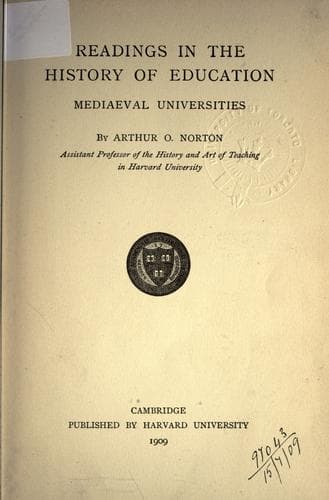
Readings in the History of Education: Mediaeval Universities — John Shaqi
Readings in the History of Education: Mediaeval UniversitiesNorton, Arthur O.
History
Readings in the History of Education: Mediaeval Universities
Norton, Arthur O.
Education, Medieval -- History -- Sources; Universities and colleges -- Europe
Abelard's fame as a teacher, with the consequent increase of masters and
students at Paris, undoubtedly paved the way for the formation of the
University later in the century. This is not however his greatest
distinction in the history of education. His most enduring influences
came from (1) his independence in thinking, (2) his novel method of
dealing with debatable questions, and (3) his contributions to
scholastic philosophy and theology. The first two of these are
considered below; the last belongs more properly to the history of
philosophy.
(1) Nothing singles Abelard out more clearly among the teachers of his
time than his intellectual independence. Most of his contemporaries
accepted unquestioningly the view that in religious matters faith
precedes reason. One might seek to justify one's faith by reason, but
preliminary doubt as to what should be the specific articles of one's
faith was inadmissible. As they supposed, these articles had been
determined by the church fathers--Augustine, Jerome, and others--and by
the Bible. Their view had been formulated by Anselm of Canterbury in the
preceding century:
"I do not seek to know in order that I may believe, but I believe
in order that I may know." "The Christian ought to advance to
knowledge through faith, not come to faith through knowledge."
"The proper order demands that we believe the deep things of
Christian faith before we presume to reason about them."
With his keenly critical, questioning mind Abelard found a flaw in this
position: on many questions of faith the authorities themselves
disagreed. "In such cases,"--he said in effect,--"how shall I come to
any definite belief unless I first reason it out?" "By doubting we are
led to inquiry, and by inquiry we attain the truth." His attitude--as
contrasted with that of Anselm, given above--is set forth in the
prologue to his _Sic et Non_ (Yes and No):
In truth, constant or frequent questioning is the first key to
wisdom; and it is, indeed, to the acquiring of this [habit of]
questioning with absorbing eagerness that the famous philosopher,
Aristotle, the most clear sighted of all, urges the studious when
he says: "It is perhaps difficult to speak confidently in matters
of this sort unless they have often been investigated. Indeed, to
doubt in special cases will not be without advantage." For
through doubting we come to inquiry and through inquiry we
perceive the truth. As the Truth Himself says: "Seek and ye shall
find, knock and it shall be opened unto you." And He also,
instructing us by His own example, about the twelfth year of His
life wished to be found sitting in the midst of the doctors,
asking them questions, exhibiting to us by His asking of
questions the appearance of a pupil, rather than, by preaching,
that of a teacher, although there is in Him, nevertheless, the
full and perfect wisdom of God.
Public-domain text, read in full here on John Shaqi.
Reviews
Reviews
No reviews yet
Be the first to share your thoughts on this work.
Join the Discussion
Join the discussion
Sign in to leave a comment or review.
Sign InorCreate an account