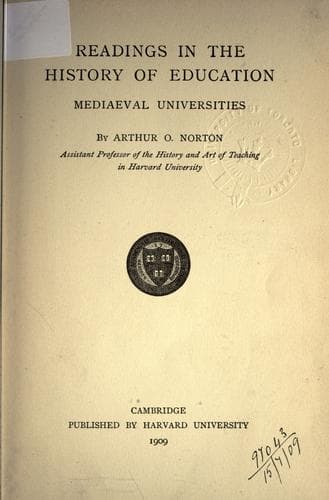
Readings in the History of Education: Mediaeval Universities — John Shaqi
Readings in the History of Education: Mediaeval UniversitiesNorton, Arthur O.
History
Readings in the History of Education: Mediaeval Universities
Norton, Arthur O.
Education, Medieval -- History -- Sources; Universities and colleges -- Europe
From hence I was withdrawn by the poverty of my condition, the
request of my companions, and the advice of my friends, that I
should undertake the office of a tutor. I obeyed their wishes;
and on my return [to Paris] after three years, finding Master
Gilbert [de la Porree] I studied Logic and Divinity with him: but
he was very speedly removed from us, and in his place we had
Robert de Poule, a man amiable alike for his rectitude and his
attainments. Then came Simon de Poissy, who was a faithful
reader, but an obtuse disputator. These two were my teachers in
Theology only.
Twelve years having passed away, whilst I was engaged in these
various occupations, I determined to revisit my old companions,
whom I found still engaged with Logic at Mont St. Genevieve, and
to confer with them touching old matters of debate; that we might
by mutual comparison measure together our several progress. I
found them as before, and where they were before; nor did they
appear to have reached the goal in unravelling the old questions,
nor had they added one jot of a proposition. The aims that once
inspired them, inspired them still: they had progressed in one
point only: they had unlearned moderation, they knew not modesty;
in such wise that one might despair of their recovery. And thus
experience taught me a manifest conclusion, that, whereas
dialectic furthers other studies, so if it remain by itself it
lies bloodless and barren, nor does it quicken the soul to yield
fruit of philosophy, except the same conceive from elsewhere.[14]
This was doubtless one of the experiences which led John to vigorous
argument on the futility of devotion to Logic alone, and on the
importance of a liberal education:
That eloquence is of no effect without wisdom is a saying that is
frequent and true. Whence it is evident that to be of effect it
operates within the limits of wisdom. Therefore eloquence is
effective in proportion to the measure of wisdom which each one
has acquired; for the former does harm if it is dissociated from
the latter.
Public-domain text, read in full here on John Shaqi.
Reviews
Reviews
No reviews yet
Be the first to share your thoughts on this work.
Join the Discussion
Join the discussion
Sign in to leave a comment or review.
Sign InorCreate an account