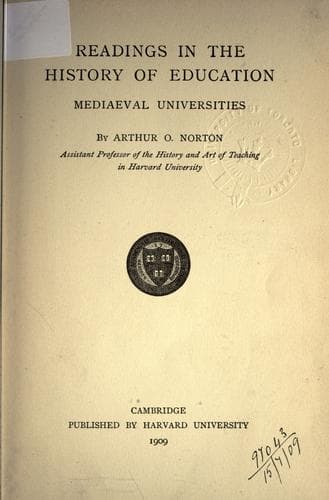
Readings in the History of Education: Mediaeval UniversitiesNorton, Arthur O.
History
Readings in the History of Education: Mediaeval Universities
Norton, Arthur O.
Education, Medieval -- History -- Sources; Universities and colleges -- Europe
From this it follows that dialectic, which is the quickest and
most prompt among the hand-maids of eloquence, is of use to each
one in proportion to the measure of his knowledge. For it is of
most use to him who knows the most and of least use to him who
knows little. For as the sword of Hercules in the hand of a pygmy
or dwarf is ineffective, while the same sword in the hand of
Achilles or Hector strikes down everything like a thunderbolt, so
dialectic, if it is deprived of the vigor of the other
disciplines is to a certain degree crippled and almost useless.
If it is vigorous through the might of the others, it is powerful
in destroying all falsehood and, to ascribe the minimum to it,
it is adequate for the proper discussion of all things ...
Now it is very easy for each workman to talk about his own art;
but to do skilfully what the art requires, is most difficult. For
what physician is there who does not talk often and much about
elements, and humors, and complexions, and diseases, and the rest
that pertain to physic? But he who gets well on such talk could
well have afforded to be even sicker. What ethical teacher has
not an abundance of rules for good living so long as they exist
only on his lips? But it is clearly a much harder task to express
them in actual life. Mechanics, individually, talk glibly about
their own arts, but not one of them so lightly vies (in practice)
with the architect or the boxer. It is the same in every other
line. So it is very easy to talk about definition, arguments, or
genus and the like, but to devise these same things within the
limits of a single art for the purpose of performing fully the
functions of the art, is far more difficult [i.e. to discuss
logic in the abstract is easy, but to reason logically in any
specific field of knowledge is difficult]. Therefore he who is
hampered by a dearth of the disciplines will not have the power
which Dialectic promises and affords.[15]
The views of John of Salisbury concerning the study of Aristotle are
indicated on pages 42-44.
2. THE NEW METHOD
The new method of study and investigation, developed by Abelard, was a
second influence of importance in the growth of universities. The method
itself--later known as the scholastic method--is illustrated on pages
20, 58, 121 ff. The present section therefore merely indicates the ways
in which it influenced the course of higher education.
(_a_) The new method was one cause of the awakened interest in study
and investigation. Its effect is thus described by the most learned
historian of mediaeval universities:
Public-domain text, read in full here on John Shaqi.
Reviews
Reviews
No reviews yet
Be the first to share your thoughts on this work.
Join the Discussion
Join the discussion
Sign in to leave a comment or review.
Sign InorCreate an account