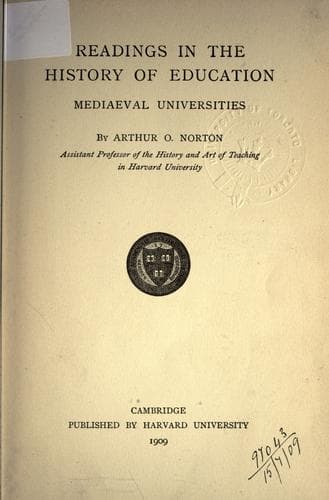
Readings in the History of Education: Mediaeval UniversitiesNorton, Arthur O.
History
Readings in the History of Education: Mediaeval Universities
Norton, Arthur O.
Education, Medieval -- History -- Sources; Universities and colleges -- Europe
During the twelfth and thirteenth centuries the intellectual life of
western Europe was enriched by the addition of a group of books, old and
new, which were destined to influence profoundly the growth of the
universities, as well as the whole course of mediaeval life and thought.
Without some such addition to the stock of learning higher education
could hardly have developed at all, for the materials available for it
previous to the twelfth century were decidedly scanty. The books
presently to be described furnished a body of advanced and solid
instruction, suited to the needs of the times. They formed one of the
permanent influences which both developed and maintained centers of
higher education, for the new learning was not less potent in
attracting students than the fame of individual teachers or the new
method of study.
The greater number of the books which formed the body of university
instruction were recoveries from the mass of ancient and long-disused
Greek and Roman learning, together with a few works of Arabic and Jewish
origin. To this group belong the works of Aristotle, the body of Roman
Law, and the medical works of Galen, Hippocrates, and various Arabic and
Jewish physicians. In the main, these had been hitherto unknown in
western Europe, or at least practically for-gotten since the days of the
Roman Empire. In the twelfth and thirteenth centuries they were
collected and made generally accessible to students. Those not
originally written in Latin were now translated into Latin; manuscript
copies were multiplied and widely diffused.
But the intellectual activity of the times accomplished much more than
the recovery of some fragments of ancient learning; it also created two
new fields of study,--Scholastic Philosophy and Theology, and Canon
Law,--and produced the text-books which marked them off as distinct and
professional studies. The book which established the _method_ of these
studies was Abelard's "Yes and No" (see p. 20); but the works which
furnished the substance of university instruction were, in Theology, the
"Sentences" (Sententiae) of Peter Lombard, and in Canon Law, the
"Decree" (Decretum) of Gratian, which was also known as the "Harmony of
Contradictory Canons" (Concordia Discordantium Canonum), and additions
thereto, indicated on page 56.
Thus, during the twelfth and thirteenth centuries, the growth of
universities was stimulated by the development of a great body of
learning hitherto inaccessible or unknown. The striking nature of this
development will be clearer if we recall that no addition to the
learning of western Europe in the least degree comparable to this had
been made during the entire seven centuries preceding.
Public-domain text, read in full here on John Shaqi.
Reviews
Reviews
No reviews yet
Be the first to share your thoughts on this work.
Join the Discussion
Join the discussion
Sign in to leave a comment or review.
Sign InorCreate an account