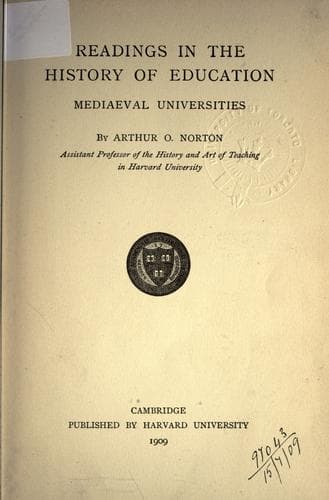
Readings in the History of Education: Mediaeval UniversitiesNorton, Arthur O.
History
Readings in the History of Education: Mediaeval Universities
Norton, Arthur O.
Education, Medieval -- History -- Sources; Universities and colleges -- Europe
Paris and Bologna experienced before all other schools, and
nearly simultaneously, at the beginning of the twelfth century,
an unexpected, almost sudden development. For in these schools
alone a definite branch of learning was treated ... by a new
method, adapted to contemporary needs, but hitherto unknown, or
insufficiently known, to other teachers of the period; and
thereby a new era of scientific investigation was inaugurated.
This new method had an attractive power for teachers and scholars
of various countries ... In this way the cornerstones of
permanent abodes of learning were laid. The continually growing
number of scholars brought with it the increase of teachers; the
desire of both classes for learning was awakened; and this
desire, and the combative exchange of ideas in the
disputations,--which now first became really established in the
schools as a result of the new method,--were effective forces to
keep investigation active, and the schools themselves from
decline.
In Paris, it was the cultivation of Logic, but chiefly the new
method in Theology, ... developed in various ways especially by
Abelard and other teachers, and extended by his contemporaries
and their disciples ... which caused the revolution in the
schools of that city.[16]
(_b_) The new method of Abelard established a new form of exposition,
and consequently a new mode of teaching, in Canon Law and in Theology.
The earliest university text-book in Canon Law--the "Decretum" of
Gratian--adopted this method, with some modifications. It was followed
in portions of the chief text-book in Theology,--the "Sentences" of
Peter Lombard. Variously modified, it became the method used in all
subsequent scholastic philosophy and theology. It was widely used in
connection with other university studies. In general, it was to
mediaeval education what the method of experiment is to the study and
teaching of modern natural science. A good illustration of its recent
use is Thomas Harper's "Metaphysic of the School."
(_c_) The scholastic method became the basis of one of the most
important university exercises,--the disputation or debate, which was
employed in every field of study.[17]
3. THE NEW STUDIES
Public-domain text, read in full here on John Shaqi.
Reviews
Reviews
No reviews yet
Be the first to share your thoughts on this work.
Join the Discussion
Join the discussion
Sign in to leave a comment or review.
Sign InorCreate an account