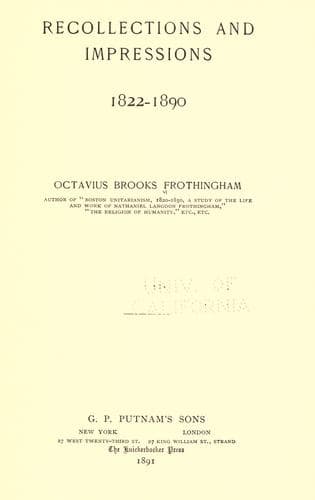
Recollections and Impressions, 1822-1890Frothingham, Octavius Brooks
Religion
Recollections and Impressions, 1822-1890
Frothingham, Octavius Brooks
Frothingham, Octavius Brooks, 1822-1895; Unitarians -- New England -- Biography
It must be remembered that Emerson was not a man of warm temperament,
not tropical in color or in heat; more like the morning, cool and
breezy, than like the sultry noon-day, or the glowing evening; more like
the dewy spring, than the effulgent summer or the fruit-bearing autumn;
not a child of the sun, rather suggesting the still, white, imaginative
moonlight. There was an air of remoteness about him. His remark to the
inn-keeper,--"heat me red-hot," tells the story. Simple habits kept his
frame wiry, and a New England nurture saved his mind from luxuriant
uncleanness. By nature he was passionless. The beautiful "Threnody" on
the death of his boy, reveals the sorrow of a soaring mind rather than
the grief of a crushed heart. To command one's self enough for such an
effort evinces a rare power of rising above mortal conditions. Such a
constitution finds solitude congenial and is calm by force of
inclination. Friendship seems an emotion better suited than love to that
ethereal soul, which was always radiant but seldom burning, benignant,
seldom craving, always gracious in imparting, seldom hungry for
receiving. One might walk in his illumination, but one could hardly bask
in his heat, or lie on his bosom, or nestle near his heart. They that
knew him at home may speak more warmly of him, but thus he appeared to
people outside; thus he appeared to many who had admired him as I did
and tried to get close to him.
The love of wild, untrimmed nature, the want of interest in cultivated
gardens, was part of his theory of the universe as the expression of
God; the richer, the less it was interfered with. He would approach as
near to the Creator as possible, listening for the divine voice, which
was most clearly heard in the wilderness. To the same source must be
ascribed his partiality for wild, untrained men,--foresters, hunters,
pioneers, trappers, back-woodsmen. He sought everywhere after
originality, freshness, power, in individuals and in groups. He hailed a
genius, however rough. Unconventionality excited his enthusiasm to such
a degree that he could scarcely contain himself, but said the most
extravagant things in the ecstasy of his hope. Men of polished outside
he did not care for; mechanical men, however successful, politicians,
however popular and adroit, were his aversion. Accomplishments, however
great, scholarship however finished, he did not respect. He wanted the
rough, uncut gem. Genius of whatever description, in whatever class,
whatever its order or grade, was his joy. In him the love of truth
predominated. He submitted to the inconvenience of imperfect opinion,
but respected the highest law of his being. He believed in the eternal
laws of mind, in the self-existence of right, in purity, veracity,
goodness. He was one of the most honest of men, one of the cleanest, and
he did his utmost to bring his life into correspondence with his best
thought. That all created things must be imperfect was part of his
Public-domain text, read in full here on John Shaqi.
Reviews
Reviews
No reviews yet
Be the first to share your thoughts on this work.
Elsewhere in the archive
Join the Discussion
Join the discussion
Sign in to leave a comment or review.
Sign InorCreate an account