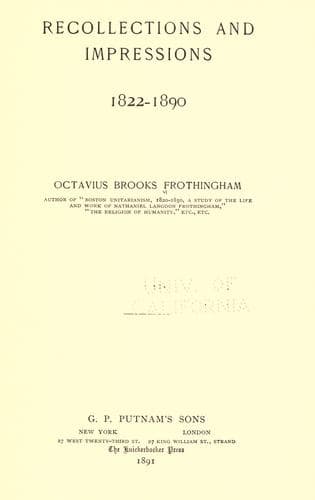
Recollections and Impressions, 1822-1890Frothingham, Octavius Brooks
Religion
Recollections and Impressions, 1822-1890
Frothingham, Octavius Brooks
Frothingham, Octavius Brooks, 1822-1895; Unitarians -- New England -- Biography
creed; that this imperfection ran through human character he was as much
convinced as any man; and his efforts were unceasing to turn men's eyes
towards the beauty "ancient but ever new," which he in his moments of
insight beheld. No one lives up to his most exalted faith. No one ever
endeavored to do so more sincerely and humbly than Ralph Waldo Emerson.
In my early ministry, the discourses of Dr. Orville Dewey on "Human
Nature," "Human Life," "The Nature of Religion," seemed all-sufficing. I
read them over and over again with increasing admiration, and his
solutions of spiritual problems were accepted as final.
Miss Mary Dewey, in the admirable memoir of her father, lays great
stress on his affectionate qualities. These cannot be too emphatically
asserted; yet they probably had more scope than even she suspected.
Indeed, unless I am much mistaken, they formed the basis of his
character. He was a most deep-feeling man. He loved his friends in and
out of the profession, with a loyal, hearty, obliging, warm, and even
tender emotion, expressing itself in word and deed. It was overflowing,
not in any sentimental manner, but in a manly, sincere way. He was a man
of infinite good-will, of a quite boundless kindness. His voice, his
expression of face, his smile, the grasp of his hand,--all gave sign of
it. He felt things keenly; his sensibilities were most acute; even his
thoughts were suffused with emotion. He could not discuss speculative
themes as if they were cold or dry. Nothing was arid to his mind. In
prayer it was not unusual for his audience to discern tears rolling down
his cheeks. One day, in his study, on speaking about the intellectual
implications of the "Philosophie Positive," he dropped his head and
seemed for a moment lost in reverie largely made up of devotion. In him,
heart was uppermost; intellect, conscience, were of subordinate value
when taken alone; in fact, they were incomplete by themselves, and
wanted their proper substance. He said once that his skin was so
delicate that the least soil on his hands was felt all through his
system and prevented him from working. This excessive sensibility, which
could not be understood by the world at large, was at the bottom of his
likes and dislikes, of his personal fears and hopes. Excitement drained
off his strength. He exhausted himself physically, and fell into
ill-health by exertions that would not have taxed an ordinary
constitution. It cost him a great deal to write sermons, to visit the
sick or sorrowing, to conduct public services. At the same time, he was
disqualified, by a certain want of steel in his blood, for any but the
clerical profession, where qualities like his are of inestimable value,
and of the rarest kind. He was a minister from the beginning, always
profoundly interested in questions of the interior life, and though he
early left the orthodox communion and became a preacher of Unitarian
Christianity, making it his work to apply religious ideas to all the
Public-domain text, read in full here on John Shaqi.
Reviews
Reviews
No reviews yet
Be the first to share your thoughts on this work.
Elsewhere in the archive
Join the Discussion
Join the discussion
Sign in to leave a comment or review.
Sign InorCreate an account