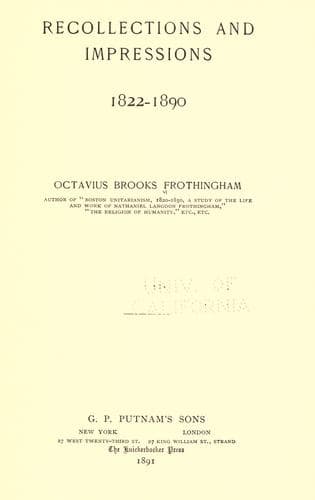
Recollections and Impressions, 1822-1890Frothingham, Octavius Brooks
Religion
Recollections and Impressions, 1822-1890
Frothingham, Octavius Brooks
Frothingham, Octavius Brooks, 1822-1895; Unitarians -- New England -- Biography
concerns of the natural world and the secular life, he retained all the
fervor of spirit that charaterized the most devout believer. A vein of
passionate feeling ran through all his discourses, and while his themes
were taken from daily existence, his thoughts were fixed on eternity. He
was absorbed in the destiny of the human soul, of the _individual_ soul,
bringing all discussions to that point, and trying to make lasting
impressions on the spiritual natures of men and women.
When I first knew him he had the reputation of being a self-indulgent
man. This was a great mistake. His way of life was exceedingly simple,
and his habits were almost abstemious. In fact, neither his physical nor
his mental constitution allowed of any indulgence in eating or drinking.
Still the impression was a natural one, for a certain amount of ease,
exemption from care, gayety, was necessary to him. The society of
elegant, accomplished people was indispensable to his recreation and
rest. His motive for seeking such was not the love of luxury so much as
a demand for recreation and a craving for repose. He was not, in any
sense, an earthy man or one who loved sensual delights. On the contrary,
he was always mindful of his calling, always intent on high subjects,
always ready to lead intercourse upwards, always, to the extent of his
power, interested in the moral aspect of current discussions;
over-anxious, if anything, to approach speculative themes. He possessed
an eager, unresting, questioning mind. He was always thinking, and on
great subjects of theology or philosophy, and he put into them an amount
of feeling that is extraordinary with intellectual men.
That he should have been so sensitive as he was to the words and
suspicions of anti-slavery men who charged him with being an advocate of
a fugitive-slave law, an apologist for slavery, a ready tool of the
inhuman, reactionary party of the country, is not surprising. His dread
of pain, his hatred of falsehood, his horror of injustice, his love of
fair play, will sufficiently account for this; while the impossibility
of explaining himself kept the wound open. That for thirty years the
sore should have bled, shows the delicacy of his temperament and the
shrinking nature of his will. To speak of him as a friend of slavery is
absurd. No one can read his sermon on "The Slavery Question," preached
shortly after the annexation of Texas and at a moment of great
excitement at the North in regard to the advances of the slave-power,
and not perceive that he was deeply moved.
Public-domain text, read in full here on John Shaqi.
Reviews
Reviews
No reviews yet
Be the first to share your thoughts on this work.
Elsewhere in the archive
Join the Discussion
Join the discussion
Sign in to leave a comment or review.
Sign InorCreate an account