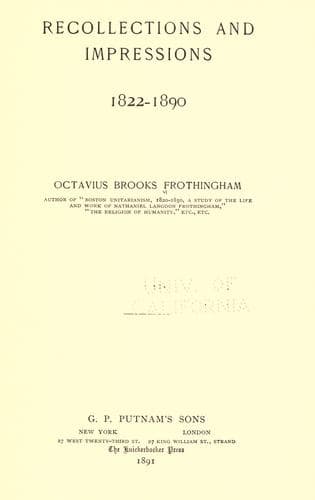
Recollections and Impressions, 1822-1890Frothingham, Octavius Brooks
Religion
Recollections and Impressions, 1822-1890
Frothingham, Octavius Brooks
Frothingham, Octavius Brooks, 1822-1895; Unitarians -- New England -- Biography
"_Are these people_ MEN?" he said; "that is the question. If they
are _men_, it will not do to make them instruments for mere
convenience,--for the mere tillage of the soil;--if they are _men_, it
is not enough to say that they have a sort of animal freedom from care,
and joyance of spirits. If they are _men_, they are to be cultivated;
their faculties are to be regarded as precious; they are to be
improved.... If he is a _man_, then he is not only improvable and ought
to be improved, but he _will improve_ in spite of all we can do." And a
great deal more to the same effect. He indignantly protested against
treating "an intelligent creature, a fellow-being, a brother-man, a
being capable of indefinite expansion and immortal progress," as one
would treat a tree, a flower, an ox, or a horse. "Grant that the African
of the present generation cannot be raised to our stature; yet if in the
course of ages he may be, and if it is our policy systematically to
arrest or to retard his growth, does the case materially differ from
what I have supposed?" Namely that of a child. Dr. Dewey visited
slave-States and talked with slave-holders in order to make himself
fully acquainted with the condition of opinion and of feeling about the
case, and he took occasion everywhere to argue the Northern side. This
ought to be enough in the way of vindication of his personal sentiments.
At the same time, he was a Unionist of the Webster school. His
attachment to the Union was intense. Disunion in his judgment meant
ceaseless discord, the end of republican institutions, the arrest of
civilization, the indefinite postponement of progress, the hopelessness
of education and uplifting for the slave, the withdrawal of Northern
influence, the final overthrow of government by moral powers. A long
reign of anarchy, in the course of which the lovers of the race must see
their visions of good disappear, would supervene, and this he could not
contemplate with equanimity.
Public-domain text, read in full here on John Shaqi.
Reviews
Reviews
No reviews yet
Be the first to share your thoughts on this work.
Elsewhere in the archive
Join the Discussion
Join the discussion
Sign in to leave a comment or review.
Sign InorCreate an account