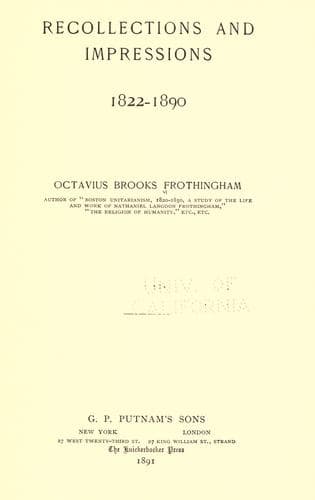
Recollections and Impressions, 1822-1890Frothingham, Octavius Brooks
Religion
Recollections and Impressions, 1822-1890
Frothingham, Octavius Brooks
Frothingham, Octavius Brooks, 1822-1895; Unitarians -- New England -- Biography
Then he was an old-fashioned enemy of war, especially of civil war. He
was a sincere lover of peace, and a believer in the arts of peace, in
industry, education, the diffusion of intelligence, the weaving of the
ties of fraternity; and though he acknowledged the heroic mission of
strife, he recoiled instinctively from it. War, in his estimation, was
an inevitable necessity in the order of the world, but it was an awful
element in the "world problem"; "a fearful scourge," a condition to be
outgrown along with vice, passion, injustice, selfishness, ambition, a
sign that is destined to disappear as intelligence and Christianity come
in. It must be submitted to as an ordination of Providence, but it
should never be precipitated by men, least of all should it be brought
on hastily, by unreasonableness, malignity, or hate. The evils of war
were precisely such as appealed most directly to his imagination; they
were so personal, they were so domestic, they were so pitiable, they
were so full of tears. He shrank from violence, from rage, from party
ambition, from curses and cries. He loved his countrymen, and, so long
as any reason remained, he could not bear to think of fighting. So long
as any oil was left in the can, the troubled waters were not to be
abandoned by the peace-makers. It was much for him to have patience with
those who used angry words, even in a cause of righteousness. He, for
his part, could not scold or overstate, or do anything in a harsh
temper.
Dr. Dewey believed in colonization; not necessarily in Africa, but in a
separation between the white and black races, in the civilization of the
negro. In the tenth lecture of the course on "The Problem of Human
Destiny" (1864), he takes occasion to welcome "the great hope" that thus
was opened "for purging our American soil from the stain of slavery.
Many of us have long been asking how this is to be done. Look at Africa,
surrounded by a wall of darkness, and filled with cruelty and blood,
with no civilizing influence in herself, as the story of ages has
proved; what now do we see? Britain sends to her borders the
man-stealer, to tear her children from her bosom and transport them to
the American colonies. It was a deed of unmingled atrocity, compared
with which capture in war was generous and honorable; the African King
of Dahomey grows white by the side of the Saxon slave-trader. But what
follows? The African people in this country improve, and are now far
advanced beyond their kindred at home. And now they begin to return;
they are building a state on their native borders which promises to stop
the slave trade with Africa and to spread light and civilization through
her dark solitudes." At the close of his discourse on the slavery
question, he said:
Public-domain text, read in full here on John Shaqi.
Reviews
Reviews
No reviews yet
Be the first to share your thoughts on this work.
Elsewhere in the archive
Join the Discussion
Join the discussion
Sign in to leave a comment or review.
Sign InorCreate an account