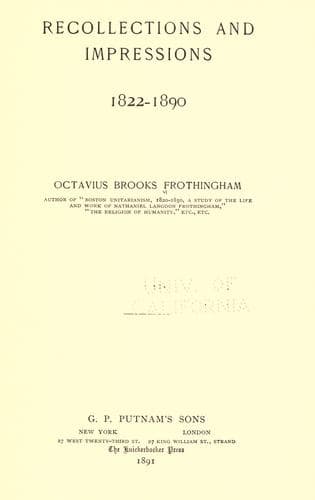
Recollections and Impressions, 1822-1890Frothingham, Octavius Brooks
Religion
Recollections and Impressions, 1822-1890
Frothingham, Octavius Brooks
Frothingham, Octavius Brooks, 1822-1895; Unitarians -- New England -- Biography
youth by birth and by disposition, prudent, careful, thrifty; his very
enthusiasm was of the New England type, the product of theological
ideas, a creation of the gospels, a desire to introduce the "Kingdom of
Heaven," a continuance of the prophetic calling. New England is as noted
for its fanaticism as it is for its theology. Its fanaticism is the
offspring of its theology, and in proportion as its theology disappears
its fanaticism decreases. In Mr. Ripley's case the theology had reached
very near to its last attenuation and the fanaticism had tapered off
into a gentle enthusiasm. He undertook to establish a kingdom of heaven
on earth because he had given up the expectation of a kingdom of heaven
in the skies; and he undertook to establish a kingdom of heaven on earth
by rational, economic means, not by religious interventions. He was
subject to that peculiar kind of excitement that comes to a few people
in connection with the keen exercise of their intellectual powers, when
they have laid hold of what seems to them a principle--an excitement
that is easily mistaken for moral earnestness even by one who is under
its influence, which, indeed, lies so close to moral earnestness as to
feel quickly the effect of moral earnestness in others, notwithstanding
the checks applied by practical wisdom. Mr. Ripley had struck on a
theory of society, which at that time was passing from the phase of
feeling into the phase of philosophy. The theory was in the air; the
most susceptible spirits were full of it; all noble impulses were in its
favor, it belonged to the order of thought he had attained; it was
native to the aspirations that inflamed the men and women with whom he
was most intimate; their feelings awoke his intellect, and he was
carried away by a stream whereof he appeared to himself to be a
tributary and whereof he appeared to others as the main current, on
account of his impetuosity, and the vigor with which he proceeded to put
the idea into practice. In his own mind he was realizing the dream of
the New Testament, but, in fact, he was testing a principle of which the
New Testament was quite unconscious, the modern principle of the equal
destinies of all men. He had abandoned the New Testament ground of
allegiance to Jehovah, and had adopted the human ground of fidelity to
social law. He was still under the spell of religious emotions, but they
had become merged in the abstractions of rationalism and merely lent an
added glow to his ideas, so that he could readily imagine that he was
actuated by spiritual convictions when, in fact, he was doing duty as a
disciple of socialist philosophers. His own interest in Brook Farm was
in the main speculative, though through his personal sympathies he was
moved toward an enterprise that had moral ends in view.
Public-domain text, read in full here on John Shaqi.
Reviews
Reviews
No reviews yet
Be the first to share your thoughts on this work.
Elsewhere in the archive
Join the Discussion
Join the discussion
Sign in to leave a comment or review.
Sign InorCreate an account