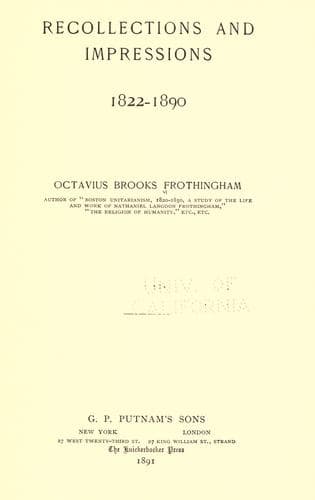
Recollections and Impressions, 1822-1890Frothingham, Octavius Brooks
Religion
Recollections and Impressions, 1822-1890
Frothingham, Octavius Brooks
Frothingham, Octavius Brooks, 1822-1895; Unitarians -- New England -- Biography
Once embarked in it, he gave his whole mind to its
accomplishment,--all his industry, all his organizing talent, all his
high sense of duty. He worked day and night; he wrote letters; he
answered inquiries; he mastered the science of agriculture; he did the
labor of a practical farmer; he maintained the supervision of the
strange family that gathered about him. Very remarkable was his success
in keeping the intellectual side uppermost, in keeping clear of the
temptations to give way to instinctive leanings. His associations were
with books and study and bright people. He brought the most brilliant
men and women of the day to the place. He awakened the interest of the
general community. He diffused an atmosphere of cheerful hope around the
experiment. It is easy to make sport of Brook Farm; to laugh at the odd
folks who came there; to ridicule their motives and actions; to repeat
stories of extravagant conduct; to tell of the eccentric behavior of men
and maidens who were right-minded but impulsive; to follow
spontaneousness to its results; to trace the course of unrestricted
liberty. But it is not fair to remember these things as peculiarities of
Brook Farm, as incidents of its conception, or as incidents that were
agreeable to Mr. Ripley. He exerted the whole weight of his character
against them. He watched and guarded. We do not hear of him in
connection with the scandals, the laxities, or the frolics. His efforts
were directed to the supremacy of ideas over instinct, the idea of a
regenerated society, something very different from joyousness, or
merriment, or the fun of having a good time. He, too, was gay; he felt
the delight of freedom; but his gayety was born of happy confidence in
the principle at stake, his delight was connected with the advent of a
new method of intercourse among men. I remember hearing him once deliver
a speech in Boston. In it he spoke of the "foolishness of preaching,"
and avowed his willingness to be a pioneer in the task of breaking out a
new future for humanity, a ditcher and delver in the work of
constructing the new building of God. He had the coming time continually
in view. Others might enjoy themselves, others might grow tired of
waiting, but he held smiling on his way, determined to carry out the
idea to the end. There was something grand in the steady intellectual
force with which he did his best to carry through a principle that
commanded more and more the assent of his reason. When the demonstration
of Charles Fourier was laid before him, no argument was required to
persuade him to adopt it. He took it up with all his energy; his
enthusiasm rose to a higher pitch than ever; the rationale of the
movement was revealed to him, and apparently he saw for the first time
the full significance of the scheme he had been conducting. The
impelling power of an intellectual conviction was never more splendidly
illustrated. Nobody discerned so clearly as he did the financial
hopelessness of the experiment.
Public-domain text, read in full here on John Shaqi.
Reviews
Reviews
No reviews yet
Be the first to share your thoughts on this work.
Elsewhere in the archive
Join the Discussion
Join the discussion
Sign in to leave a comment or review.
Sign InorCreate an account