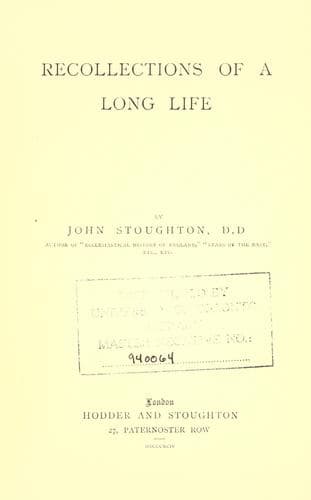
Clergy -- England -- Biography; Stoughton, John, 1807-1897
The coronation of William IV. and Queen Adelaide indicated a change in
that august ceremonial, which showed how reform touched royal pageantry.
Though an instance of a double coronation, it came short of the elaborate
display when the previous monarch sat alone in Edward’s chair. I saw the
procession going down to Westminster, along a narrow street at Charing
Cross—old-fashioned shabby shops standing where now you catch sight of
palatial hotels—old Northumberland House, with its gardens, occupying the
space now become a broad avenue. The beefeaters, the trumpeters, and the
footmen in attendance upon the gaudy state-coach, with its royal
occupants, were very picturesque. And what a crush there was to avoid
the mob streaming down from the Haymarket!
All sorts of reports were afloat, tending to make the new king popular.
It was said, that immediately after his accession, he came to town in the
dickey of his carriage, and invited, after an unceremonious manner, his
old naval friends to come and dine with him. A story went the round with
rare applause that, after the defeat of the Reform Bill, when he wanted
to dissolve Parliament, he said if the royal carriages could not be got
ready, he would go in a hackney coach. How far such tales were true I do
not know; but a nobleman, present at one of His Majesty’s dinner-parties
at the Brighton Pavilion, told me that, on that occasion, the king
toasted some of his guests in sailor fashion, and remarked that his
seafaring pursuits had scarcely fitted him for a throne. Then, pointing
to the queen, he added that for any improvement in his ways he was
indebted to that good lady. The story raised him in my estimation and
that of many others.
I must now turn from politics and royalty to what was more in my own way.
The Rev. Daniel Wilson, afterwards Bishop of Calcutta, stood high amongst
London Evangelicals as Vicar of Islington, and I sometimes heard him in
his crowded church; but my great delight was to walk down to Camberwell
to listen to Henry Melvill, then in the zenith of his popularity. His
manner was peculiar—he had a curious shake of the head, and a strange
inflection of voice at the end of a sentence, which kept up attention.
As to style, he was artificial in the extreme; every paragraph seeming to
be planned on the same model, ending with the words of his text as a
well-turned climax. The preacher swept his auditors along with the force
of a torrent from point to point. I heard him at Barnes, when he was
advanced in life, deliver one of his old discourses, I should judge
little, if at all, altered; but it lacked the fire of early days, and the
congregation evinced little of the sympathy which seemed to quiver in
London churches at the sound of his voice twenty or thirty years before.
Public-domain text, read in full here on John Shaqi.
Reviews
Reviews
No reviews yet
Be the first to share your thoughts on this work.
Join the Discussion
Join the discussion
Sign in to leave a comment or review.
Sign InorCreate an account