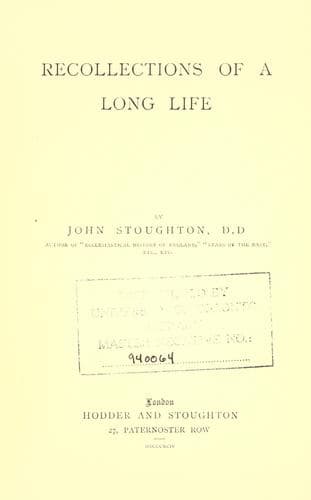
Clergy -- England -- Biography; Stoughton, John, 1807-1897
Rowland Hill, though a very old man in 1830, continued to fill Surrey
Chapel with a crowded audience. I listened to a sermon in which he
recommended young people when they set up house-keeping to secure one
piece of furniture especially—_i.e._, the looking-glass of a good
conscience, so that husband and wife, keeping it clean, might see
themselves in it, with joy and thankfulness; “for a good man is satisfied
from himself,” and, he added, “so is a good woman.” John Angell James,
of Birmingham, was one of the most popular preachers at that time, and he
occasionally occupied Surrey Chapel pulpit; but William Jay, of Bath, was
a more regular “supply,” and echoes of his sonorous voice I still catch
as I read his pithy and impressive sermons. When he came to preach
Rowland Hill’s funeral sermon I had left college, and he honoured me with
an invitation to preach for him at Bath the Sunday following. In 1886,
when I occupied the same pulpit in my old age, a lady told me that she
remembered my being there more than fifty years before, when the people
wondered at their pastor’s sending “such a boy to take his place.” A
similar occurrence had happened when Jay first preached for Rowland Hill.
James Parsons, of York, was a frequent visitor to London, and used to
occupy for several Sundays in the year the pulpit of Moorfields
Tabernacle, and that of Tottenham Court Chapel. Congregations gathered
an hour before service to listen to this youthful preacher. He had been
educated for the law, and, with a strong taste for rhetorical efforts,
had cultivated, by the study of English authors, his own extraordinary
gift for public speaking. Almost inaudible at first, his voice would
gradually rise into tones shrill and penetrating; and after repeated
pauses, when people relieved themselves by bursts of coughing, he would,
during his peroration, wind them up to such a pitch of excitement as I
have never witnessed since. He was thoroughly evangelical and devout,
and did an immense deal of spiritual good. I became intimately
acquainted with him in after-years, and found in his friendship a source
of much enjoyment. His conversations in the parlour were as full of
anecdote and humour as his sermons in the pulpit were of pathos and
power. I have heard a member of Parliament, one of his deacons at York,
say that Mr. Parsons’ eloquence in early days was perfectly electrifying,
and that, as he listened to him at that time, he felt as if he must lay
hold on the top of his pew to prevent being swept away by the force of
the preacher’s appeals.
Public-domain text, read in full here on John Shaqi.
Reviews
Reviews
No reviews yet
Be the first to share your thoughts on this work.
Join the Discussion
Join the discussion
Sign in to leave a comment or review.
Sign InorCreate an account