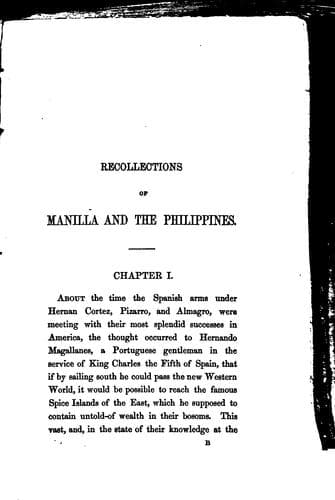
Recollections of Manilla and the Philippines: During 1848, 1849 and 1850 — John Shaqi
Recollections of Manilla and the Philippines: During 1848, 1849 and 1850MacMicking, Robert
History
Recollections of Manilla and the Philippines: During 1848, 1849 and 1850
MacMicking, Robert
Manila (Philippines); Philippines
The Government of Spain has, ever since the period of their
acquisition, shown itself ignorant or neglectful of the commercial
importance of these islands, the commerce of which has long been
subjected to regulations and restrictions as injurious in their
tendency as can well be imagined,--they being framed, apparently at
least, more for the purpose of smothering it in its earliest existence
than with any kindly or paternal views of nourishing and increasing it.
But a change having at length once begun, a new era may be said
to have commenced with regard to them, and it is to be hoped that
increasing wisdom and liberality of ideas may clear away some of the
remaining obstacles which for so long encumbered, and even yet impede
and circumscribe within a very narrow circle, the natural course of
their commerce. For the Spanish Government are far from following a
similar policy to that of the great Henry the Fourth of France, who,
as an encouragement to the manufacturing industry of the country,
rewarded those silk manufacturers who had carried on business for
twelve years, with patents of nobility, as men who by doing so not
only benefited themselves, but deserved well of their country for
their enterprise and commercial spirit. Don Simon Anda was about
the first person who showed any desire to augment the trade of the
islands; and his election to the highest offices of the colony,
after its restoration by the English, was a most fortunate event for
Manilla. Although, unluckily, many of the steps he took with the best
intentions, notwithstanding being infinitely in advance of those of
his predecessors in office, were not always in the right direction,
and consequently unattended by the highest degree of success which he
aimed at, partial good results were obtained by them, and a beneficial
change began to regulate affairs.
The expulsion of the Jesuits from the Philippines in 1768, by throwing
their immense estates out of cultivation, and also the wars and
disturbances subsequent to the French Revolution, being felt even in
this remote part of the world, were attended with the worst effects
to the trade and agriculture of the islands. On the peace of 1814,
the condition of the country was truly deplorable, as, during a
long period of isolation and inactivity, abuses had multiplied to an
alarming extent, and the minds of the Indian population especially
had become divided between superstition and sedition, from each of
which a sanguinary catastrophe resulted. Public opinion at the time
fastened on the priests the guilt of the massacre of the Protestant
foreigners at Manilla in 1820, and the growing discontent of the
people blew into open rebellion in 1823, under a Creole leader,
who then rose and attempted to shake off the Spanish authority.
Public-domain text, read in full here on John Shaqi.
Reviews
Reviews
No reviews yet
Be the first to share your thoughts on this work.
Join the Discussion
Join the discussion
Sign in to leave a comment or review.
Sign InorCreate an account